

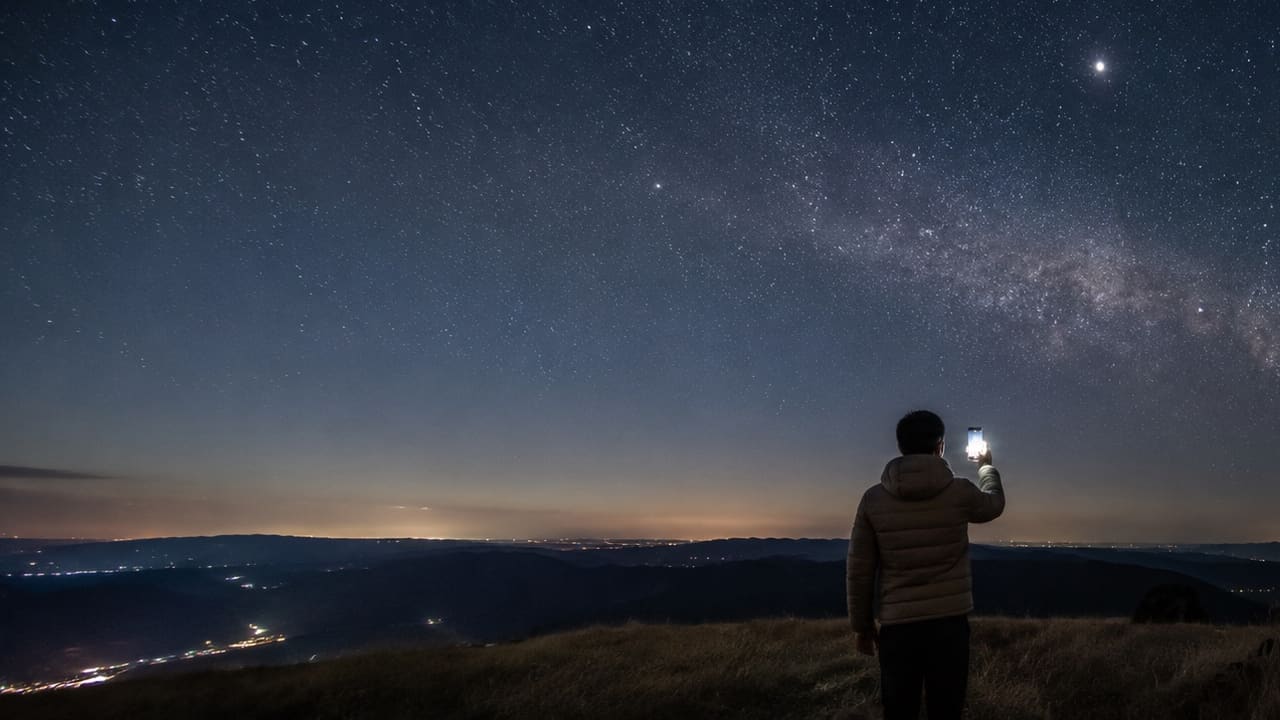
Whether you have just named a star for someone you love, spotted a bright point of light you cannot identify, or simply want to learn your way around the night sky, the question is the same: how do you find one specific star among thousands? The good news is that every star has a precise address, and once you understand how that address works, you can find any star with nothing more than your eyes, a free phone app, or a telescope.
This guide covers every method, from the thirty-second app approach to reading a certificate, looking a star up in the official science catalogues by its HIP number, hopping to it by eye, and pointing a telescope - or an observatory's telescope - straight at it. It is written to be skimmed: jump to whatever you need from the contents below.
Every star has an address: Right Ascension & Declination
Astronomers treat the sky as a giant sphere wrapped around the Earth, and they give every star a two-part address that works exactly like longitude and latitude on a map. Learn to read those two numbers and you can find anything.
The two numbers, in plain English
- Right Ascension (RA) - the sky's longitude. It is measured in hours, minutes and seconds (from 0h to 24h) because the sky appears to turn once a day. One hour of RA equals 15 degrees.
- Declination (Dec) - the sky's latitude. It is measured in degrees from 0° at the celestial equator up to +90° at the north celestial pole and down to −90° at the south. Degrees split into arcminutes (′) and arcseconds (″).
Polaris, the North Star, sits at a declination of almost +90° - which is precisely why it hangs above the Earth's North Pole and barely moves all night.
Reading the coordinates on your certificate
If you have named a star, your certificate lists its coordinates. Here is how to decode a typical line, digit by digit:
| On your certificate | What it means |
|---|---|
| RA 20h 25m 58s | 20 hours, 25 minutes, 58 seconds of Right Ascension - how far along the sky it sits. |
| Dec +47° 58′ 06″ | Just under 48 degrees north of the celestial equator - how far up it sits. |
| HIP 11767 | The star's entry number in a real science catalogue (see below) - the most useful number on the page. |
| Constellation: Cygnus | The region of sky to look in - your rough starting point by eye. |
What "J2000" means
You may see J2000 printed next to the coordinates. Earth wobbles slowly on its axis (a motion called precession), so star coordinates drift over centuries. To keep everyone consistent, catalogues freeze positions as they were at a standard reference moment - 1 January 2000 - and label them "J2000." Every app and telescope understands this format, so you never have to convert anything.
The fastest way: find your star with an app
If you only do one thing, do this. A free stargazing app turns your phone into a window on the sky: hold it up, and augmented reality labels every star you point it at. It is the quickest route from a certificate to the real thing.
Step by step
- Install a star app (see the comparison below) and allow it access to your location and motion sensors.
- Open the search tool - usually a magnifying-glass icon.
- Type your star's identifier. The most reliable input is the catalogue number (for example
HIP 11767) or the raw coordinates (RA and Dec). A pet name from a certificate will not be in the app's database, but the HIP number and coordinates always are. - Follow the arrow. The app draws a path across the sky; walk your phone along it until the target is centred.
- Look up. Match what is on screen to the real sky. On a clear night, under reasonably dark skies, you can now point to the exact spot.
Tip: Many named stars are faint - often between magnitude 8 and 14, which is below what the naked eye can see. The app will still show you the precise spot; to actually see the star there you may need binoculars or a telescope. More on that below.
The best star-finder apps in 2026
All of these will get you to a patch of sky. They differ in how precisely you can enter a catalogue number or coordinates, and whether they offer an augmented-reality "point your phone" mode. If you named your star with us, start with our own free app - it skips the coordinates entirely.
| App | Platforms | Cost | Find by HIP / coordinates | AR sky mode | Best for |
|---|---|---|---|---|---|
| Night Sky · Star Finder Ours | iOS, Android, Web | Free | Enter your registration number - it jumps straight to your star's coordinates | Yes | Instantly finding a star you named with Star-Register |
| Stellarium (desktop) | Windows, macOS, Linux | Free & open-source | Yes - type HIP 11767 or paste RA/Dec | No (desktop) | The most powerful free planetarium; perfect for planning |
| Stellarium Web | Any browser | Free | Yes - search box accepts names & catalogue IDs | No | Zero install; check a star from any device |
| Stellarium Mobile / Plus | iOS, Android | Free; Plus is a paid upgrade | Yes - full catalogue search | Yes | Free mobile app with serious search |
| SkySafari | iOS, Android | Free tier; Plus & Pro paid | Yes - deep catalogue & coordinate "GoTo" | Yes | Enthusiasts; can also drive a Go-To telescope |
| Sky Tonight | iOS, Android | Free with in-app purchases | Search by name & catalogue; coordinate view | Yes | Friendly search and "what's visible tonight" |
| Star Walk 2 | iOS, Android | Free with ads; paid removes them | Name search; AR-led | Yes | Beautiful, beginner-friendly AR |
| SkyView Lite | iOS, Android | Lite free; full version paid | Name search; AR-led | Yes | The simplest point-and-identify experience |
Which should you pick? If you named your star with Star-Register, our free Night Sky · Star Finder app is the shortcut - type in your registration number and augmented reality points your phone at the exact spot, no coordinates required (App Store · Google Play). To paste in a raw HIP number or RA/Dec for any star, use Stellarium or SkySafari. For a casual "hold my phone up and label the sky" experience, any of the AR apps above works beautifully.
Catalogue numbers: HIP, HD, Gaia & the "NASA register" myth
That short code on your certificate - HIP 11767 - is the most scientifically meaningful thing on the page. Here is what it is and how to use it.
What a HIP number is
HIP stands for the Hipparcos Catalogue, produced by the European Space Agency's Hipparcos satellite - the first space mission built purely to measure star positions. It operated from 1989 to 1993, and its final catalogue of 118,218 stars was published in 1997, with positions accurate to about a milliarcsecond. A HIP number is simply a star's entry number in that catalogue. Polaris, for instance, is HIP 11767.
The catalogue numbers you might meet
HIP is one of several naming systems astronomers use. You may see any of these on a certificate or in an app:
| Designation | What it is | Example |
|---|---|---|
| Bayer letter | Greek letter + constellation, roughly by brightness (from 1603) | α Centauri (Alpha Centauri) |
| Flamsteed number | Numbered within a constellation, in order across the sky | 61 Cygni |
| HD (Henry Draper) | A ~225,000-star spectral catalogue from Harvard, 1918–1924 | HD 8890 (= Polaris) |
| HIP (Hipparcos) | 118,218 stars measured from space by ESA, 1997 | HIP 11767 (= Polaris) |
| Gaia DR3 | ESA's modern survey - nearly 2 billion sources, including very faint stars | Gaia DR3 5853498713190525696 (Proxima Centauri) |
Look up your star for free
You do not need to buy anything to confirm your star is real. Several free, official science tools let you look up a HIP number and see the star's full data:
- SIMBAD (run by the Strasbourg Astronomical Data Centre) - type
HIP 11767into its search box and it returns every cross-identification, the exact coordinates, and the brightness. This is the astronomers' own reference. - VizieR - hosts the original Hipparcos and Tycho catalogues for browsing.
- In-The-Sky.org - a friendlier, browsable version of the Hipparcos catalogue.
- ESA Gaia Archive - the cutting-edge survey data, if you want to go deep.
Once you have confirmed the star and its coordinates in SIMBAD, you can plug the very same numbers into any app or telescope above.
A note on the "NASA star register"
People often ask where the "NASA register" of named stars is. There is a simple answer: it does not exist. NASA does not run a star-naming register and never has. NASA's own educational pages state plainly that the International Astronomical Union (IAU) is the only body that officially names stars, and that a purchased name "will not be listed in any file except the one the company who takes your money keeps."
The IAU is equally clear: it "dissociates itself entirely from the commercial practice" of selling star names, and around 600 stars carry an official IAU proper name as of 2026. We think being straight about this matters. When you name a star with a reputable register, you are buying a real, checked-for-duplicates dedication tied to a genuine catalogued star and its coordinates - a lovely symbolic gift - not an official scientific designation. The HIP number and coordinates are what make it findable; the name is what makes it meaningful.
The catalogue number and coordinates are the scientifically real part of any star gift - they are what let you, or an observatory, point straight at it.
Finding your star by eye: star hopping
Before phones, astronomers navigated the sky by "star hopping" - starting at a bright, obvious star and stepping to fainter ones using known patterns. It is a genuinely useful skill, and it is how you confirm you are looking at the right region.
Measuring distances with your hand
Held at arm's length, your hand is a surprisingly good ruler for angles in the sky:
| Hand shape (arm extended) | Angle it covers |
|---|---|
| Tip of your little finger | about 1° |
| Three middle fingers together | about 5° |
| A clenched fist | about 10° |
| Thumb to little finger, fully spread | about 25° |
Classic star hops worth knowing
- Find north: the two pointer stars of the Big Dipper's bowl aim at Polaris.
- "Arc to Arcturus, spike to Spica": follow the curve of the Dipper's handle to the orange star Arcturus, then continue to Spica.
- Orion's Belt: its three stars point down-left to Sirius (the brightest night star) and up-right to orange Aldebaran.
- The Summer Triangle: Vega, Deneb and Altair form a huge triangle overhead on summer nights - a great anchor for the Milky Way.
- Cassiopeia: the "W" on the opposite side of Polaris from the Dipper, useful when the Dipper is low.
Give yourself dark skies
How many stars you can see depends enormously on light pollution, described by the Bortle scale (1 = pristine, 9 = inner city). It sets a hard limit on the faintest star (the highest "magnitude") your eyes can reach:
| Bortle class | Where | Faintest star by eye (approx.) |
|---|---|---|
| 1–2 | True dark-sky site | magnitude 7.5+ |
| 4 | Rural / suburban edge | magnitude ~6.5 |
| 5 | Suburban | magnitude ~6 |
| 7 | Suburban / urban transition | magnitude ~5 |
| 8–9 | City centre | magnitude ~4 (only the brightest) |
Quick habits that help
- Let your eyes dark-adapt for 20–30 minutes - and protect that adaptation with a red light, not white.
- Observe when the target is high, on a night with no Moon and low humidity.
- Get away from direct lights; even a hedge between you and a streetlamp helps.
Finding your star with a telescope
A telescope does two things for star-finding: it gathers far more light (so you can see stars far too faint for the naked eye) and, if it is a "Go-To" model, it can drive itself to a set of coordinates automatically.
The three telescope types, briefly
| Type | How it works | Good to know |
|---|---|---|
| Refractor | A lens at the front | Sharp, low-maintenance, great on bright stars; costs more per inch of aperture |
| Reflector / Dobsonian | A mirror at the back | The most light-gathering for your money; bulkier |
| Catadioptric (SCT / Mak) | Lens + mirror combined | Compact and often sold with computerised Go-To mounts |
Using a Go-To mount to type in the coordinates
This is the telescope equivalent of the app method, and the most reliable way to land on a named star.
- Set up and align. Level the mount and complete the star alignment the handset asks for (typically centring two or three bright stars it names). This teaches the mount where it is pointing.
- Open the coordinate entry. On the handset, choose the option to enter RA/Dec (sometimes under "User Object" or "GoTo Coordinates"), or search by catalogue number if the database supports it.
- Type your star's RA and Dec exactly as printed on the certificate.
- Press GoTo. The motors slew the telescope straight to that point. Your star is now in - or very near - the eyepiece.
No computer? A manual equatorial mount has setting circles - dials marked in RA and Dec. Once the mount is polar-aligned and calibrated on a known bright star, you can dial in your coordinates by hand and find the field the old-fashioned way.
Will you actually see it?
Set your expectations before you look. A star is a point of light - even at high magnification it stays a point, so extra "power" does not help; aperture (light-gathering) is what lets you see fainter stars. Rough limits:
| Equipment | Faintest star it reaches (approx.) |
|---|---|
| Naked eye, dark sky | magnitude ~6 |
| Naked eye, city | magnitude ~3–4 |
| 10×50 binoculars | magnitude ~9–10 |
| Small 4-inch telescope | magnitude ~11–12 |
| 8-inch telescope | magnitude ~13+ |
Because many gift-named stars sit around magnitude 8 to 14, a pair of binoculars or a modest telescope is often exactly what turns "the right spot" into "there it is."
Seeing your star at an observatory
If you do not own a telescope, a public observatory is the best seat in the house - and staff there can point a large, precise instrument at any coordinates you give them. Thousands of observatories run public nights; you can find an observatory near you in our directory.
What to bring
- Your certificate - it carries the coordinates and catalogue number.
- The coordinates written clearly - RA and Dec, and the HIP number if you have one.
- Warm clothes and a red torch - observatory domes are cold and kept dark.
What to ask - and how to ask it
Here is the honest, practical part. Observatory staff generally will not recognise a commercial gift name, and some politely decline requests framed that way. The trick is to ask in the language they use - coordinates:
- "Could you point the telescope to Right Ascension [your RA] and Declination [your Dec]?" Modern Go-To telescopes slew straight to those numbers.
- "The star is catalogued as HIP [your number], in the constellation [name]." Giving the catalogue ID lets staff confirm the exact star.
- Ask when it is best placed - a star is only visible when it is above the horizon, which depends on your latitude, the date and the time of night.
Set expectations kindly: if your star is faint, ask staff what it will look like through their instrument. Often it is a modest point of light - but seeing your point of light, through a serious telescope, at coordinates you brought yourself, is a genuine thrill.
Observatory etiquette
- Arrive early and check opening times before you travel - public-night schedules vary by season.
- Use only red light near the telescopes to protect everyone's night vision.
- Ask before touching anything, and be patient - everyone is queuing for the same eyepiece.
The one-page checklist
- Get the address. Note your star's RA, Dec and HIP number (from the certificate or the star catalogue).
- Confirm it is real. Look the HIP number up free on SIMBAD.
- Find the spot fast. Type the HIP number or coordinates into Stellarium or SkySafari and follow the arrow.
- Orient by eye. Use a star hop (pointer stars to Polaris) to confirm the region.
- See it. Use binoculars or a telescope for faint stars - enter the coordinates on a Go-To mount, or bring them to an observatory.
- Pick your night. Dark, Moonless, target high in the sky.
Frequently asked questions
How do I find a star I named?
Use the coordinates and HIP number on your certificate, not the name (the name lives only in the register's database). Type the HIP number or the RA/Dec into a free app like Stellarium, or bring those numbers to an observatory. If the star is faint, you will need binoculars or a telescope to see it once you are pointed at the right spot.
Can I see my named star with the naked eye?
Sometimes, but often not. Many named stars are magnitude 8 to 14 - fainter than the roughly magnitude 6 limit of the unaided eye under dark skies. The app or coordinates will always show you the correct spot; a pair of binoculars or a small telescope reveals the star itself.
Is there a NASA register of star names?
No. NASA does not run a star-naming register, and no space agency sells star names. The only body that officially names stars is the International Astronomical Union, and it names only a few hundred stars through a formal scientific process. Commercial star naming is a symbolic gift, not an official designation - which is why we are upfront about exactly what it is.
What is a HIP number?
It is a star's entry number in the Hipparcos Catalogue, produced by the European Space Agency and published in 1997 with 118,218 stars. It is a real, permanent scientific identifier - the most useful number on a star certificate, because you can look it up free on SIMBAD and type it into planetarium apps and telescopes.
How do I use Right Ascension and Declination to find a star?
Treat them as the sky's longitude and latitude. Enter both numbers into a stargazing app's search box or a Go-To telescope's coordinate entry, and it will guide you to the exact point. You never need to convert anything - coordinates are given in the standard J2000 format that every app and telescope understands.
Which free app is best for finding a specific star?
If you registered your star with Star-Register, our free Night Sky · Star Finder app is quickest - enter your registration number and it points you straight there. For entering a raw catalogue number or precise coordinates for any star, Stellarium (free on desktop, mobile and web) is the most capable, with SkySafari a strong alternative that can also control a telescope. For a fun augmented-reality view where you just hold your phone up to the sky, Star Walk 2, Sky Tonight and SkyView all work well.
Keep reading
More honest, beginner-friendly guides from our blog:
- How naming a star actually works - what you really get, and how names are kept unique.
- Find your star with a stargazing app - the fastest method, step by step.
- The best constellations to spot - learn the sky so you can hop to your star.
- What NASA does - and doesn't - do with star names - the myth, debunked.
- Double stars, explained - two suns, one orbit, and how to see them.
- Why a named star makes a memorable gift - occasions, names and presentation.
And from our partner star registers:
- A Beginner's Guide to Stargazing - StarRegistration.net
- Amazing Places to Stargaze - StarRegistration.net
- Can You Name a Star With the IAU? - LabelStars.com
- Where to Buy a Star: An Honest Guide - LabelStars.com
Ready to make a star your own? Name a real, visible star and you will receive its exact coordinates and catalogue details - everything you need to follow this guide and find it in the night sky. Or find an observatory near you and go see it through a proper telescope.