
What kind of star is Proxima Centauri?
Proxima Centauri, catalogued as Alpha Centauri C (V645 Centauri), appears in the official constellation Centaurus. Its apparent visual magnitude is about 11.13; flare variable, while its estimated distance is 4.2465 light-years. Astronomers classify the object as M5.5 Ve red dwarf flare star. These labels describe temperature, luminosity class or system components; they should not be read as a claim that every naked-eye point is a single isolated star.
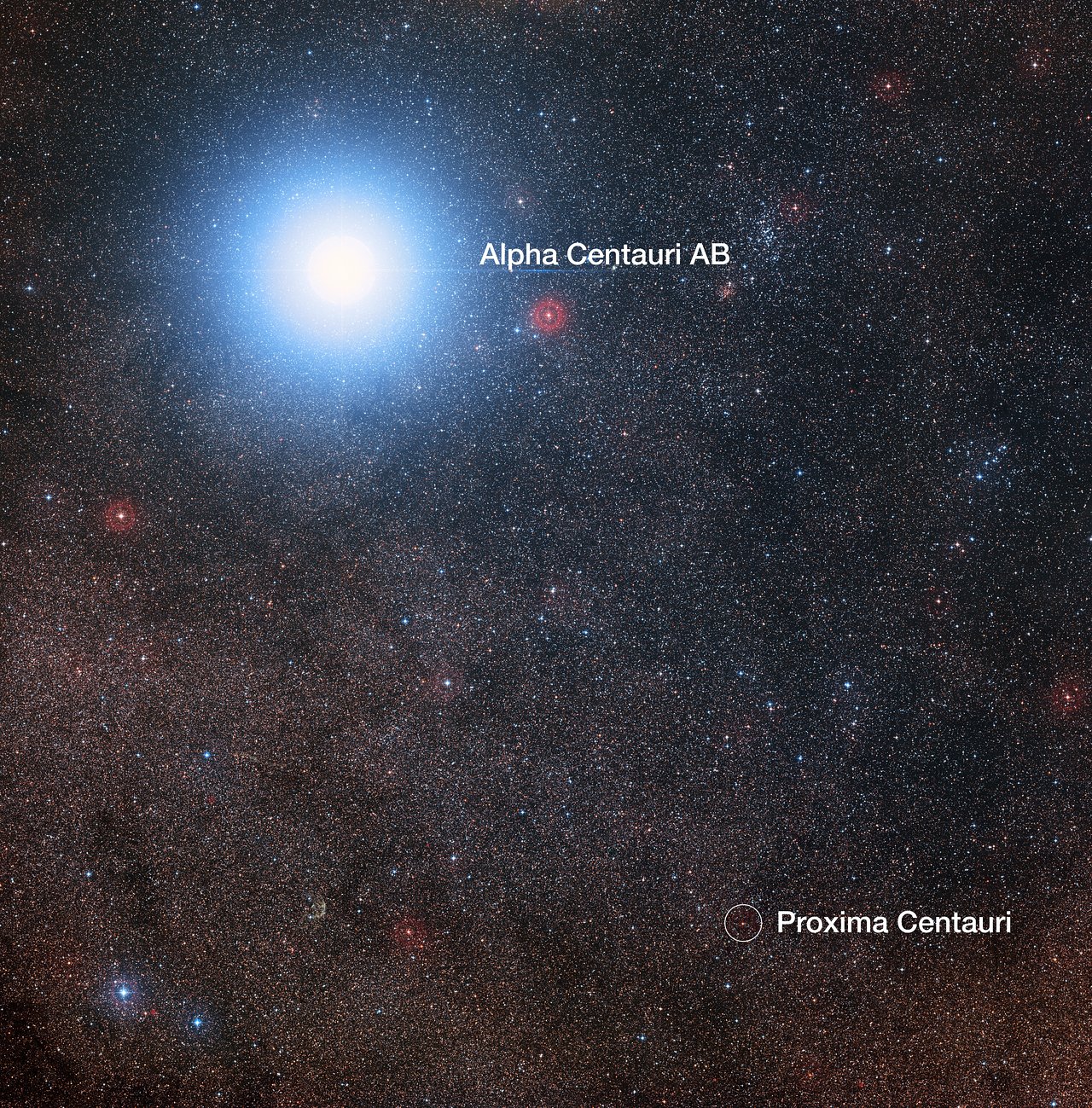
Proxima is a low-mass red dwarf that releases much of its energy at infrared wavelengths and will remain on the main sequence far longer than the Sun. Magnetic activity drives strong flares and ultraviolet or X-ray outbursts, central to any assessment of its planets' atmospheric evolution. Proxima b has a minimum mass near Earth's and orbits in the star's conventional habitable zone, but “habitable zone” describes possible surface-energy conditions, not evidence of oceans or life. Other reported signals in the system have different confidence levels and should be checked against current exoplanet archives. Proxima is gravitationally associated with Alpha Centauri AB despite its enormous projected separation from the bright inner pair.
The coordinate pair RA 14h 29m 42.95s, Dec −62° 40′ 46.1″ fixes the object's direction on the celestial sphere for the J2000 reference epoch. Right ascension works like celestial longitude measured in hours, while declination works like latitude north or south of the celestial equator. Proper motion and improved measurements can refine catalogue positions, but these coordinates are sufficiently precise for a finder chart or planetarium search.
Proxima Centauri data at a glance
| Proper name | Proxima Centauri | Catalogue designation | Alpha Centauri C (V645 Centauri) |
|---|---|---|---|
| Constellation | Centaurus | Apparent magnitude | about 11.13; flare variable |
| Spectral or system type | M5.5 Ve red dwarf flare star | Estimated distance | 4.2465 light-years |
| Right ascension (J2000) | 14h 29m 42.95s | Declination (J2000) | −62° 40′ 46.1″ |
Values are rounded for an observer-friendly overview. Consult the linked SIMBAD record for component-level identifiers, bibliography, measurement provenance and newer catalogue values.
The name Proxima Centauri
The Latin name Proxima Centauri means “nearest [star] of Centaurus.” Robert Innes proposed it after measuring its large proper motion and parallax; the IAU later standardized the familiar two-word name.
Scottish-born astronomer Robert Innes announced the high-proper-motion star in 1915 from South Africa and soon recognized that it appeared slightly closer than Alpha Centauri AB. The finding extended a long campaign to identify the Sun's nearest stellar neighbour. The 2016 announcement of Proxima b then made the faint star a prime target for exoplanet atmosphere, stellar-flare and direct-imaging studies worldwide.
Modern professional catalogues retain identifiers such as the Bayer designation alongside a proper name. The International Astronomical Union standardizes which name belongs to which component—an important distinction for systems whose combined light looks like one star from Earth.
How to find Proxima Centauri
Proxima lies more than two degrees from the brilliant Alpha Centauri AB pair, so it does not share the same telescopic field. Use a detailed current chart because its large proper motion changes its position over time. A modest telescope can show its reddish eleventh-magnitude point from a dark southern site.
A far-southern telescopic star, never visible to the unaided eye and generally inaccessible north of about 27° N. Visibility on a particular night still depends on latitude, season, time, horizon obstructions, weather and local light pollution. Use the interactive atlas below to check the surrounding field before observing.
Observation checklist
- A telescope and a detailed finder chart are essential.
- Use coordinates updated for the observing date because proper motion is large.
- Do not search in the same eyepiece field as Alpha Centauri AB.
- Expect a faint red point, not a visually resolved disc or visible planet.
Interesting facts about Proxima Centauri
- Proxima is the nearest known star to the Sun.
- It is the distant third stellar member of the Alpha Centauri system.
- Powerful flares can rapidly change its ultraviolet and X-ray output.
- Proxima b completes an orbit in about 11.2 days.
- Its apparent separation from Alpha Centauri AB exceeds two degrees.
Continue from Proxima Centauri into the night sky
Use the Centaurus constellation guide to place this star within its larger pattern. When you are ready to observe, compare dark-sky places, find a nearby observatory, or follow our practical guide to finding a star in the night sky. Symbolically registered names are kept separately in the searchable Star-Register catalogue.
Sources and further reading
Measurements are rounded for readability. Multiple systems, variable stars and distant supergiants can have component-specific or model-dependent values. Survey panels show photographic sky fields, not the physical surface of the star.