
Enchanted Rock State Natural Area

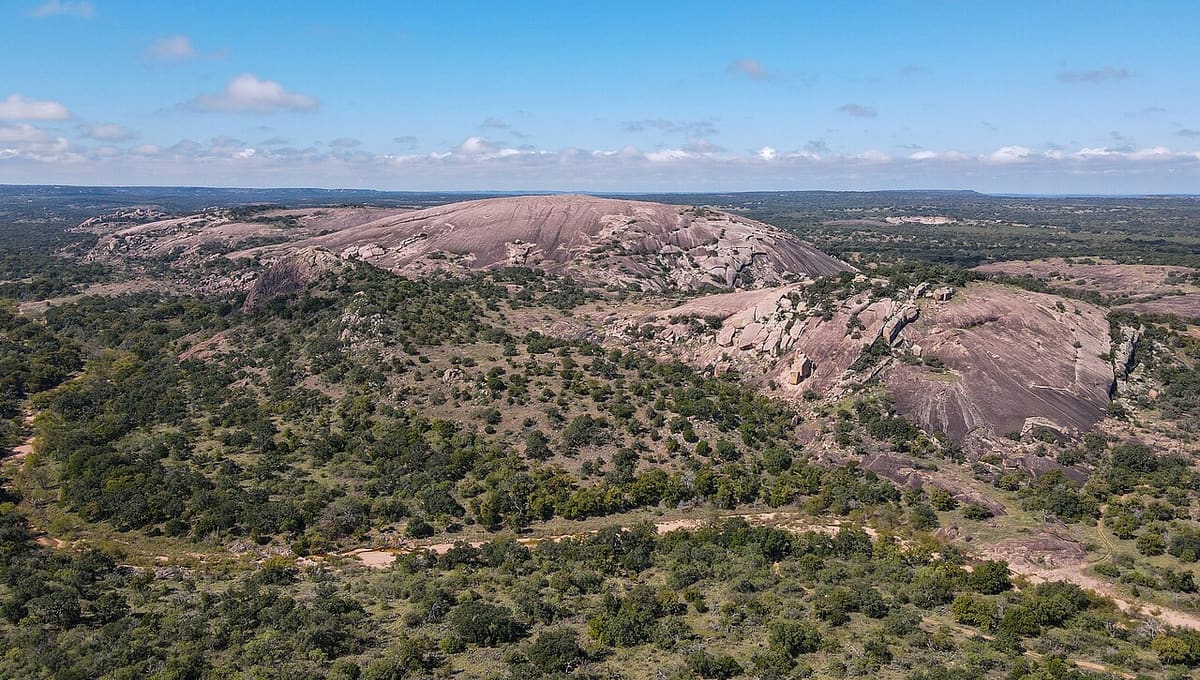
Image: Jmbuytaert · CC BY-SA 4.0 · Wikimedia Commons
Enchanted Rock State Natural Area is a 5,388-acre reserve in Gillespie and Llano counties, Texas, centred on a 425-foot pink granite dome. Opened in 1984 and managed by the Texas Parks and Wildlife Department, it is a certified International Dark Sky Park roughly 90 miles from both San Antonio and Austin.
Why Enchanted Rock is a top stargazing spot
The park measures Bortle Class 3, and its rural setting, well outside the light domes of Central Texas' two largest cities, makes it one of the best public stargazing spots in the region. Sky quality is not just a claim here: a sky quality meter run by the Putman Mountain Observatory and the Hill Country Dark Sky Monitors network publishes real-time readings for the area every 15 minutes, and values above 21.5 magnitudes per square arcsecond, which the park regularly reaches on clear nights, count as genuinely dark sky.
What you can see
On clear nights the Milky Way is visible above the granite dome, along with a dense scattering of stars rarely seen from San Antonio or Austin. The open rock summit gives an unusually wide, unobstructed view of the sky in every direction, which is part of why it draws both casual visitors and dedicated astronomers.
Visiting Enchanted Rock at night
The park is open 6:30 AM to 8 PM daily, and the Loop Trail stays accessible after sunset for stargazers. Entry costs $8 per day for anyone 13 or older, with children 12 and under free, and reservations are required on weekends, school breaks and holidays; day-pass reservations can be booked up to 30 days ahead. Note that the park headquarters building closes at 4:30 PM and the nearest gas station or store is 18 miles away, so fuel up and pack supplies before you arrive. Enchanted Rock hosts organised astronomy programming through partners including the Austin Astronomical Society, with a Summer Star Party run alongside the Hill Country Astronomers and a Spring Star Party with Texas Dark Sky, plus ranger-led night hikes. Check the Texas Parks and Wildlife dark skies page for upcoming event dates.
Best time to go
The core of the Milky Way rises highest in the evening sky roughly from March through September in the northern hemisphere, so warmer months give the most dramatic views from the summit, while winter nights trade that for crisp views of Orion and the bright winter constellations. Meteor watchers should note the Perseids peak in mid-August and the Geminids in mid-December, with the Quadrantids offering a sharper, colder peak in early January. Whatever the season, plan around the new Moon for the darkest skies, give your eyes 20 to 30 minutes to fully dark-adapt once you arrive, and use a red light rather than a white one to protect your night vision. For more on tracking down a specific point in the sky, see our guide on how to find a star in the night sky.
Getting there
Enchanted Rock sits off Ranch Road 965 roughly 18 miles north of Fredericksburg and about 90 miles from both San Antonio and Austin, making it a manageable evening trip from either city. There is no fuel or grocery store at the park itself, so stop in Fredericksburg or another town on the way in.
See your named star from here
Enchanted Rock's Bortle 3 skies and open granite summit make it a natural place to find a star you have named with Star Register. Bring your certificate's coordinates and a stargazing app, then explore the catalogue or check for nearby observatories to help you find it.
Conditions and access vary by season. Check the official website and Google Maps before you travel, and aim for a clear night near the new Moon for the darkest sky.
Satellite imagery: Esri, Maxar, Earthstar Geographics

 43 kmCommunity
 79 kmCommunity
 89 kmCommunity
 95 kmDark Sky Park