
Very Large Telescope

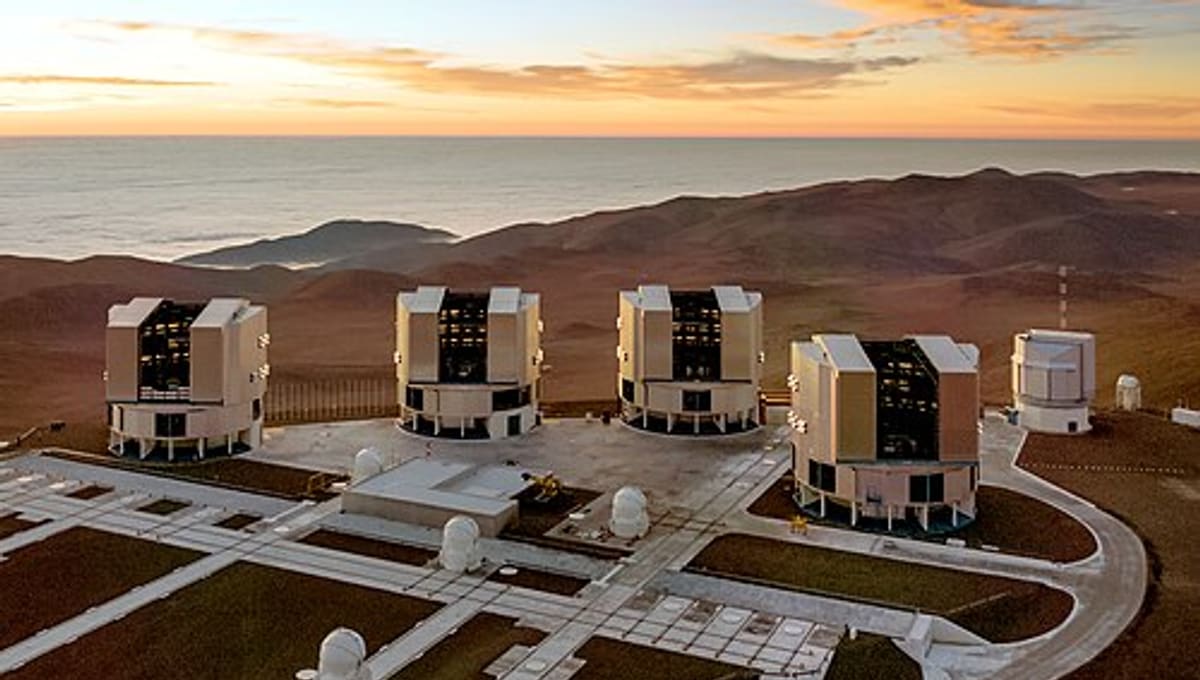
Image: Wikimedia Commons
On the summit of Cerro Paranal, high in Chile's Atacama Desert, the Very Large Telescope (VLT) ranks among the most powerful optical observatories on Earth, operated by the European Southern Observatory (ESO).
About the Very Large Telescope
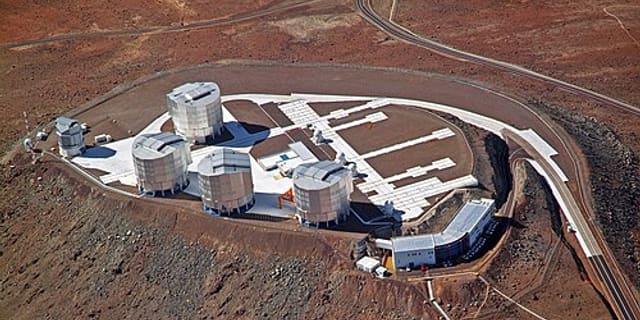
The VLT is not a single instrument but an array: four Unit Telescopes, each with an 8.2-metre primary mirror, joined by four smaller, movable Auxiliary Telescopes with 1.8-metre apertures. The four main telescopes carry Mapuche names — Antu, Kueyen, Melipal and Yepun — and are usually run separately, though they can be combined for extremely high-resolution observations. Each Unit Telescope alone can detect objects roughly four billion times fainter than the human eye can see.
History
ESO has operated the VLT on Cerro Paranal since 1998, at an elevation of 2,636 metres, chosen for its dark skies and exceptionally stable atmosphere.
Telescopes & research
Working alone, each Unit Telescope achieves an angular resolution of about 0.05 arcseconds; combined, the array can reach roughly 0.002 arcseconds, among the sharpest views available from the ground. The VLT observes across visible and infrared wavelengths and is, by output, the second most scientifically productive facility working at visible wavelengths, behind only the Hubble Space Telescope. Its observations include the first direct image ever taken of an exoplanet, the tracking of stars orbiting the supermassive black hole at the centre of the Milky Way, and studies of the afterglow from the most distant known gamma-ray burst.
Location & getting there
Cerro Paranal sits in the remote Atacama Desert of northern Chile, one of the driest and clearest places on the planet for astronomy, roughly 130 km south of Antofagasta.
Visiting the Very Large Telescope
The VLT is a working scientific research facility rather than a public visitor centre, so access is limited. Check ESO's official website for any organised visit programmes before planning a trip.
See your named star from here
The VLT's mirrors are built to resolve some of the faintest, most distant light in the universe — a reminder of just how precisely a star's coordinates can be pinpointed. Name a star of your own and receive its exact right ascension and declination, then explore other named stars in the catalogue.
Opening hours and public-visit programs vary by season. Check the official website and Google Maps for current times before you travel.
Institutional and reference sources used to verify this guide.
Satellite imagery: Esri, Maxar, Earthstar Geographics

 under 1 km
 2 km
2 kmTolar astronomical observatory
astronomical observatory in Salta Province, Argentina

 489 km