
SPECULOOS-South Observatory

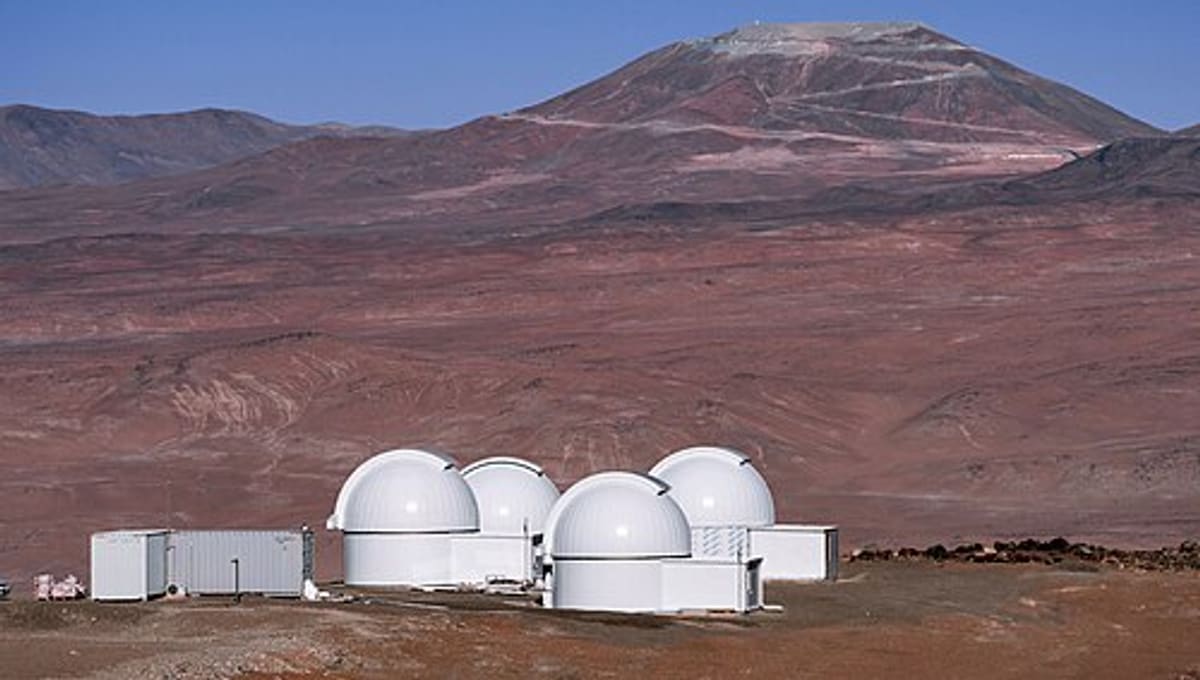
Image: Wikimedia Commons
SPECULOOS-South Observatory sits at ESO's Paranal site in Chile's Atacama Desert, a robotic facility built to search for Earth-sized planets around small, cool stars.
About SPECULOOS-South Observatory
Founded in 2017 and led by astronomer Michaël Gillon at the University of Liège, SPECULOOS stands for Search for habitable Planets EClipsing ULtra-cOOl Stars. The observatory began its first scientific observations in January 2019 and forms part of a wider international network that also includes a Northern Observatory in Tenerife and the SAINT-Ex facility in Mexico.
Telescopes & research
The site operates four 1-metre robotic telescopes, each named after one of Jupiter's Galilean moons: Io, Europa, Ganymede, and Callisto. Europa achieved first light in April 2017, with Io following that October and the remaining telescopes coming online by the end of the same year. Each telescope carries a near-infrared-sensitive CCD camera with a resolution of 0.35 arcseconds per pixel, tuned to detect the transits of Earth-sized planets as they cross in front of ultra-cool dwarf stars.
Location & getting there
Paranal Observatory rises from the Atacama Desert, one of the driest and darkest places on Earth, already home to the European Southern Observatory's Very Large Telescope and several other major instruments.
Visiting SPECULOOS-South Observatory
SPECULOOS-South operates as a robotic research facility within the Paranal site; check ESO's Paranal visitor programme for current information on tours of the wider observatory complex.
See your named star from here
A network built to spot Earth-sized planets transiting distant stars relies on pinpointing exact sky coordinates, the same coordinates that define a star named through Star Register. Search the catalogue for your star and see where it lies above the Atacama Desert.
Opening hours and public-visit programs vary by season. Check Google Maps for current times before you travel.
Institutional and reference sources used to verify this guide.
Satellite imagery: Esri, Maxar, Earthstar Geographics

 2 km
2 km
 2 km
2 kmTolar astronomical observatory
astronomical observatory in Salta Province, Argentina

 490 km