
Korea Microlensing Telescope Network-CTIO


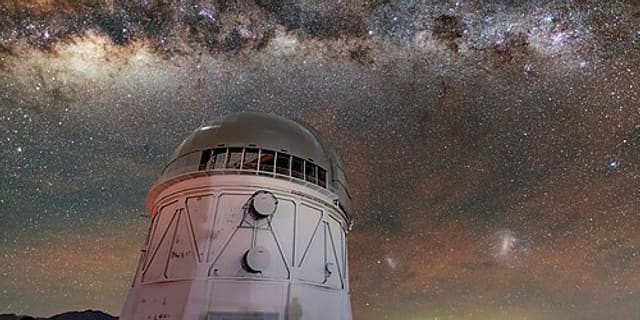
Image: Wikimedia Commons
At Cerro Tololo Inter-American Observatory in Chile, one of three identical KMTNet telescopes scans the southern sky for the faint flicker of distant exoplanets.
About Korea Microlensing Telescope Network-CTIO
Korea Microlensing Telescope Network-CTIO is a 1.6-metre wide-field optical telescope sited at Cerro Tololo Inter-American Observatory in Chile. It is one of three identical telescopes, spread around the globe near latitude -30°, that make up the Korea Microlensing Telescope Network (KMTNet).
Telescopes & research
Each KMTNet telescope carries a mosaic of four 9k-by-9k pixel CCD cameras, giving a field of view of about four square degrees and a pixel scale of 0.4 arcseconds, wide enough to monitor dense star fields continuously. Commissioned in 2015, the network's purpose is to detect extrasolar planets through gravitational microlensing, watching for the brief brightening caused when a foreground star and planet pass in front of a background star. Because the three telescopes are spread around the globe, they can watch the same patch of sky around the clock. As of 2025, KMTNet observations have contributed to confirming more than 230 microlensing planets.
Location & getting there
The telescope sits at Cerro Tololo Inter-American Observatory in the Chilean Andes, a high, dry site prized for its clear skies.
Visiting Korea Microlensing Telescope Network-CTIO
As a specialised research telescope operating within Cerro Tololo Inter-American Observatory, it isn't set up for casual visitors on its own; anyone hoping to see it should check Cerro Tololo's official visiting arrangements before travelling.
See your named star from here
KMTNet-CTIO spends its nights fixed on precise coordinates across the southern sky, hunting for the tiniest changes in starlight. When you name a star with Star Register, you get its own right ascension and declination - explore the star catalogue to find yours.
Opening hours and public-visit programs vary by season. Check Google Maps for current times before you travel.
Institutional and reference sources used to verify this guide.
Satellite imagery: Esri, Maxar, Earthstar Geographics

 under 1 km
 under 1 km
 10 km
10 km