
Cerro Tololo Inter-American Observatory

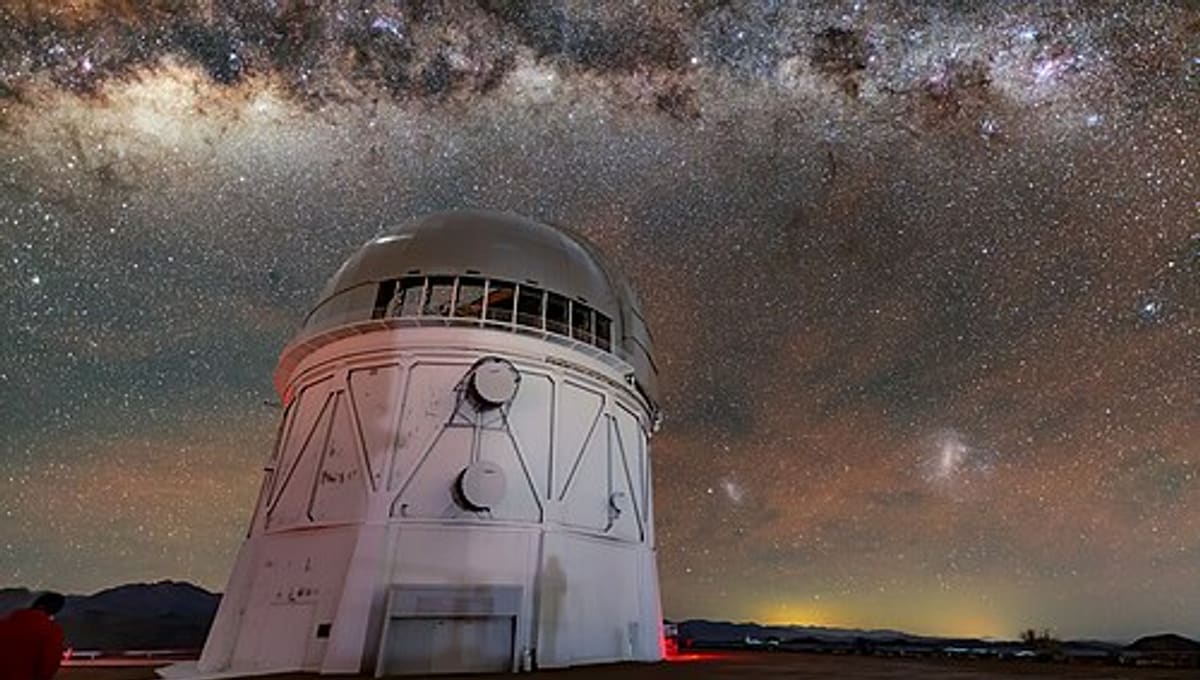
Image: Wikimedia Commons
Cerro Tololo Inter-American Observatory (CTIO) crowns a mountain in Chile's Coquimbo Region, about 80 kilometres east of La Serena, and has been a cornerstone of Southern Hemisphere astronomy since the 1960s.
About Cerro Tololo Inter-American Observatory
CTIO is operated by NOIRLab, the U.S. National Optical-Infrared Astronomy Research Laboratory, under the Association of Universities for Research in Astronomy (AURA) and with funding from the National Science Foundation. Sitting at 2,207 metres, the site takes advantage of the region's clear, dry skies to support both large survey telescopes and long-running research programmes.
History
The observatory was founded in 1962, with construction beginning the following year under its first director. Regular astronomical observations commenced in 1965, and the site has operated continuously ever since, growing from its original mountaintop into a broader complex with support facilities in nearby La Serena.
Telescopes & research
The principal instrument is the Víctor M. Blanco Telescope, a 4-metre reflector completed in 1974 and named for the Puerto Rican astronomer. CTIO also oversees the Southern Astrophysical Research Telescope (SOAR), a 4.1-metre instrument on nearby Cerro Pachón dedicated in 2004, and the SMARTS consortium's smaller 1.5, 1.3, 1.0 and 0.9-metre telescopes. The site hosts several ongoing research programmes, including PROMPT (gamma-ray burst follow-up), WHAM (mapping warm ionised gas), GONG (helioseismology) and the MEarth Project, which searches for exoplanets around small stars.
Location & getting there
CTIO sits in Chile's Coquimbo Region, roughly 80 kilometres from the coastal city of La Serena, where the observatory's support and administrative facilities are based. The mountaintop setting, shared with nearby Cerro Pachón, is part of the same high, arid corridor that has made northern Chile one of the world's premier sites for astronomy.
Visiting Cerro Tololo Inter-American Observatory
NOIRLab runs public visits to CTIO; check the official website for current tour schedules, transport arrangements and any booking requirements before travelling, as access to the mountain is controlled.
See your named star from here
Every star named through Star Register comes with exact coordinates, so a telescope at a research site like CTIO could, in principle, be pointed straight at it. Name a star of your own or explore the catalogue of stars already named.
Opening hours and public-visit programs vary by season. Check the official website and Google Maps for current times before you travel.
Institutional and reference sources used to verify this guide.
Satellite imagery: Esri, Maxar, Earthstar Geographics

 under 1 km
 10 km
10 km