
Hyper-Kamiokande
Satellite imagery: Esri, Maxar, Earthstar Geographics
Deep under Mount Nijuugo in Japan's Gifu Prefecture, the Hyper-Kamiokande observatory is being built to catch some of the universe's most elusive particles: neutrinos from the Sun, the atmosphere, and the cosmos beyond.
About Hyper-Kamiokande
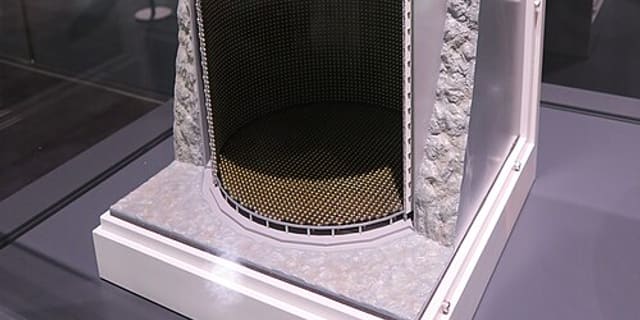
Hyper-Kamiokande, also known as Hyper-K or HK, is a neutrino observatory and experiment under construction across two sites in Japan: the main detector beneath Mount Nijuugo in Hida, Gifu Prefecture, and a set of near and intermediate detectors in Tokai, Ibaraki Prefecture, connected to the J-PARC accelerator complex. It is run by the University of Tokyo and the High Energy Accelerator Research Organization (KEK), together with institutes from more than 20 countries across six continents.
History
Hyper-Kamiokande is designed as the successor to the Super-Kamiokande and T2K experiments, extending their search for proton decay and their study of neutrino oscillations to a much larger scale. Data-taking is planned to begin in 2028.
Telescopes & research
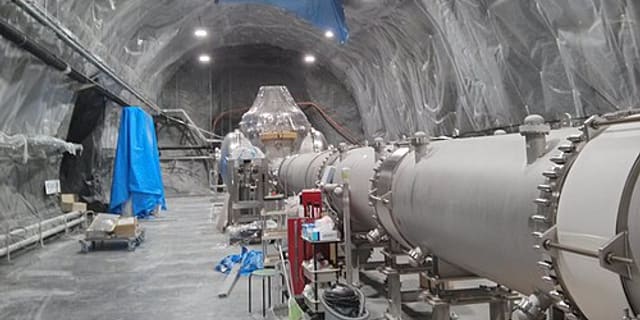
The main detector beneath Mount Nijuugo is built to search for proton decay and to detect neutrinos arriving from natural sources, including Earth, the atmosphere, the Sun, and the wider cosmos. The Tokai detectors also let researchers study oscillations in a man-made accelerator neutrino beam produced at J-PARC, measured at the distance of the first oscillation maximum from the main detector.
Location & getting there
The facility spans two locations in Japan: Hida in Gifu Prefecture, where the main underground detector sits beneath Mount Nijuugo in the Japanese Alps, and Tokai in Ibaraki Prefecture, home to the near and intermediate detectors and the J-PARC accelerator.
Visiting Hyper-Kamiokande
As a large underground research facility still under construction, Hyper-Kamiokande is not a general public visitor site in the way a small local observatory is. Check the official project website for any public outreach events or facility information before planning a visit.
See your named star from here
Hyper-Kamiokande studies neutrinos rather than starlight, so it won't help you spot a named star directly, but its mission of tracing particles back to the Sun and cosmos shares the same spirit of connecting a point in the sky to something you can call your own. Name a star with Star Register and use its coordinates with a stargazing app or at a dedicated optical observatory. Browse the catalogue of named stars.
Opening hours and public-visit programs vary by season. Check the official website and Google Maps for current times before you travel.
Satellite imagery: Esri, Maxar, Earthstar Geographics

 under 1 kmResearch
 under 1 km
Kamioka Liquid Scintillator Antineutrino Detector
neutrino oscillation experiment in Japan
Kamioka Observatory
underground neutrino and gravitational wave observatory in Kamioka, Japan