
Super-Kamiokande

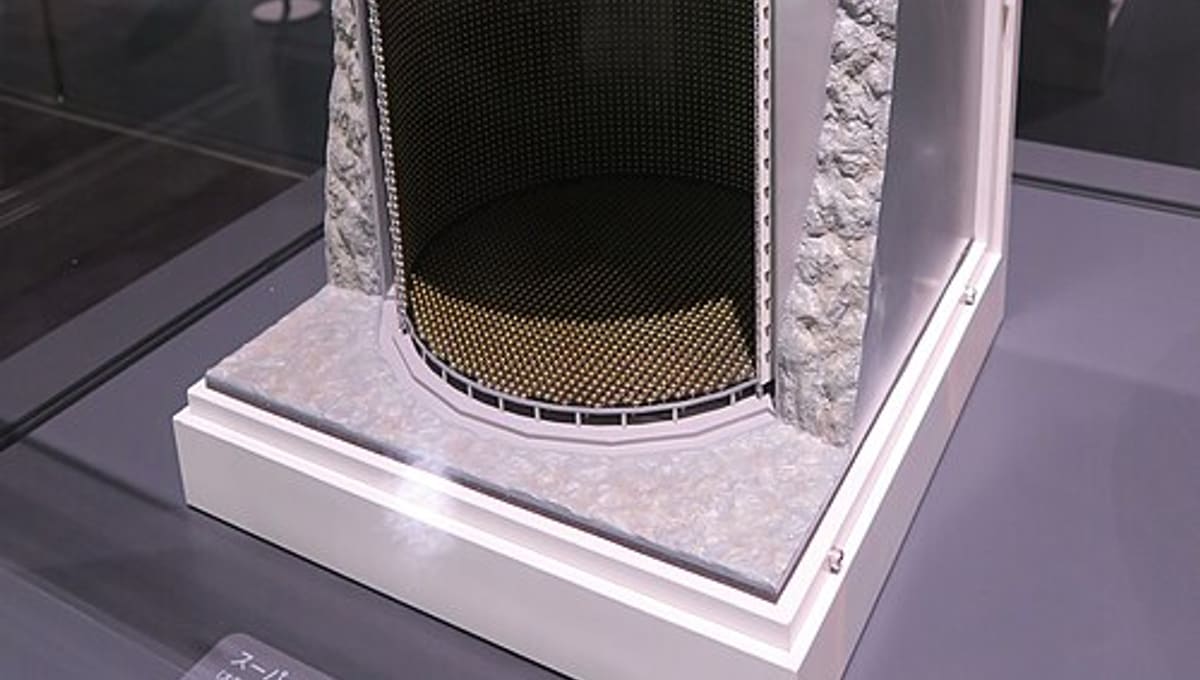
Image: Wikimedia Commons
Super-Kamiokande is a neutrino observatory buried 1,000 metres underground in the Mozumi Mine near Mount Ikeno, in the city of Hida, Gifu Prefecture, Japan.
About Super-Kamiokande
Also known as Super-K or SK, short for Super-Kamioka Neutrino Detection Experiment, it has operated since 1991 under the Institute for Cosmic Ray Research at the University of Tokyo, with an international team of collaborators.
Telescopes & research
Rather than an optical telescope, Super-Kamiokande is a Cherenkov detector built to catch high-energy neutrinos. Its research covers the search for proton decay, the study of solar and atmospheric neutrinos, and continuous watch for supernovae in the Milky Way.
Location & getting there
The detector sits deep beneath Mount Ikeno in Gifu Prefecture, in central Japan, chosen for the rock overburden that shields its instruments from cosmic ray interference. Use the map and directions button on this page for the general location.
Visiting Super-Kamiokande
As an active underground research facility, Super-Kamiokande is not a general public stargazing venue and we don't have confirmed public visiting information. Check the official website of the Institute for Cosmic Ray Research for any public outreach events before planning a trip.
See your named star from here
Super-Kamiokande is tuned to catch neutrinos rather than starlight, so it isn't a place to point a telescope at your named star. But the same right ascension and declination that identify a star named through Star Register can be found with an optical telescope at observatories elsewhere in our network. Name a star or browse the full catalogue of named stars.
Opening hours and public-visit programs vary by season. Check the official website and Google Maps for current times before you travel.
Institutional and reference sources used to verify this guide.
Satellite imagery: Esri, Maxar, Earthstar Geographics

 under 1 km
Kamioka Liquid Scintillator Antineutrino Detector
neutrino oscillation experiment in Japan
Kamioka Observatory
underground neutrino and gravitational wave observatory in Kamioka, Japan