
Kamioka Observatory
Satellite imagery: Esri, Maxar, Earthstar Geographics
In the mountains of Gifu Prefecture, the Kamioka Observatory occupies a former mine deep beneath the city of Hida, where thick rock shields some of the world's most sensitive neutrino and gravitational-wave detectors from cosmic-ray interference.
About Kamioka Observatory
Kamioka Observatory, formally the Institute for Cosmic Ray Research (ICRR) facility of the University of Tokyo, is an underground laboratory built inside the Mozumi mine, once operated by the Kamioka Mining and Smelting Company. Over more than two decades it has hosted a succession of neutrino experiments that have reshaped particle physics.
History
The underground facility began operating in 1983, and in 1996 it was formally established as the Institute for Cosmic Ray Research (ICRR) of the University of Tokyo. Since then it has become one of the world's leading centres for neutrino astronomy and neutrino oscillation research.
Telescopes & research
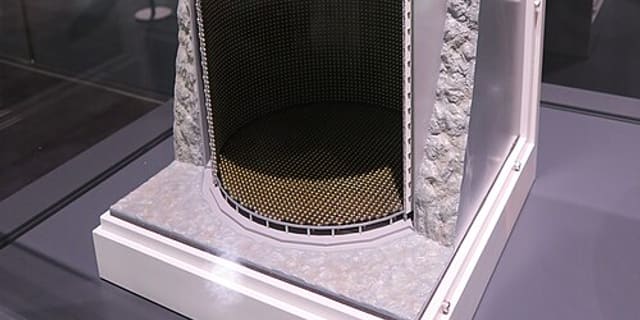
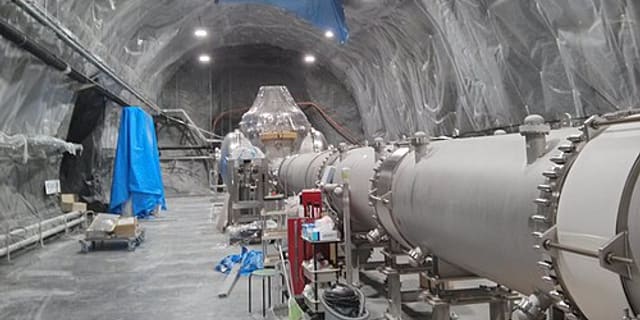
Rather than optical telescopes, Kamioka Observatory hosts large underground detectors that use the mine's rock overburden as natural shielding. Multiple neutrino experiments have run here over the decades, contributing key results to neutrino astronomy and to the study of neutrino oscillation - work that has helped establish that neutrinos have mass.
Location & getting there
The observatory lies underground in the Kamioka area of Hida city, Gifu Prefecture, in the mountains of central Honshu. Its depth and the surrounding rock are essential to its science, filtering out the cosmic-ray background that would otherwise swamp its detectors.
Visiting Kamioka Observatory
As an active underground research facility, Kamioka Observatory is not a general tourist attraction. Anyone interested in a visit or in current public outreach activities should check the ICRR's official website for up-to-date information before planning a trip.
See your named star from here
Kamioka's detectors are built to catch particles from stars and reactors alike by tracking exact directions and timing. A named star from Star Register comes with its own precise coordinates, ready to explore in our star catalogue or point out with any stargazing app, wherever you are.
Opening hours and public-visit programs vary by season. Check the official website and Google Maps for current times before you travel.
Institutional and reference sources used to verify this guide.
Satellite imagery: Esri, Maxar, Earthstar Geographics
Kamioka Liquid Scintillator Antineutrino Detector
neutrino oscillation experiment in Japan

 2 kmResearch
 2 km
2 km