
Kamioka Gravitational wave detector

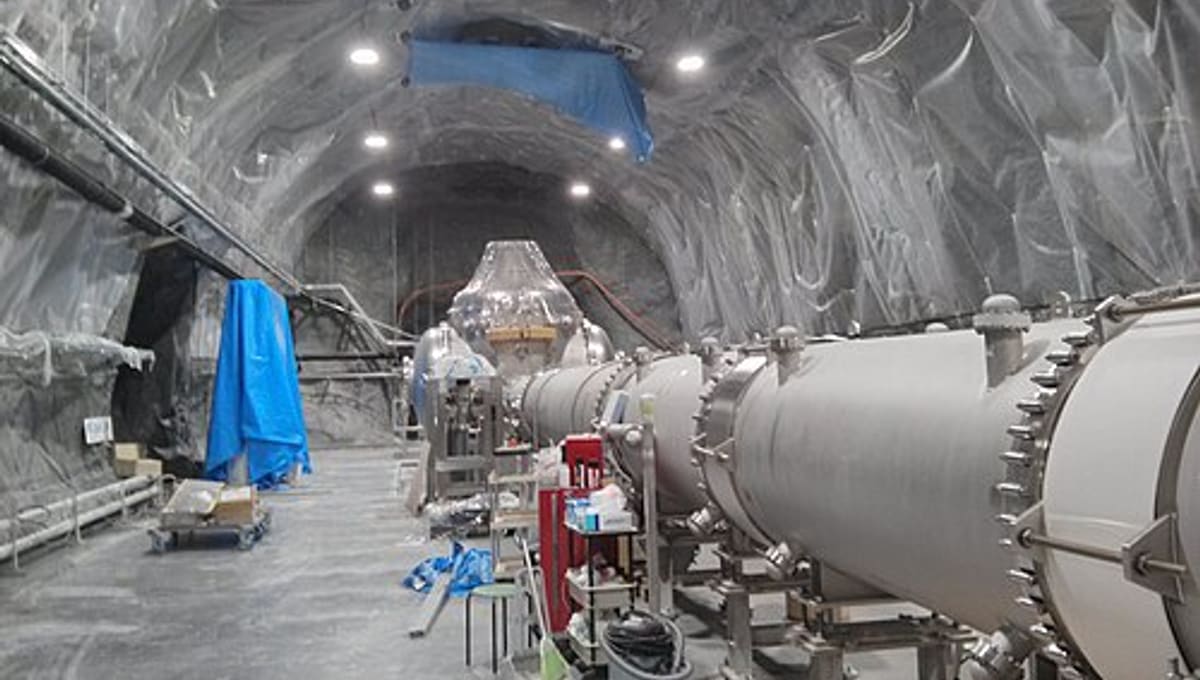
Image: Wikimedia Commons
The Kamioka Gravitational Wave Detector, known as KAGRA, is a large-scale physics experiment built underground near the city of Hida in Gifu Prefecture, Japan, designed to catch ripples in spacetime itself.
About Kamioka Gravitational Wave Detector
KAGRA is a Michelson interferometer with 3-kilometre arms, built to detect gravitational waves predicted by Einstein's general theory of relativity, including signals from merging binary neutron stars up to roughly 150 megaparsecs away. It is operated jointly by the Institute for Cosmic Ray Research (ICRR) at the University of Tokyo, the High Energy Accelerator Research Organization (KEK), and the National Astronomical Observatory of Japan (NAOJ), and is part of the international LVK collaboration alongside LIGO in the United States and Virgo in Italy.
History
First conceived in the late 1990s, KAGRA was formally approved in 2010, with construction completed in 2019 and observations beginning in 2020. It is notable as Asia's first gravitational-wave observatory, the first such detector built underground anywhere in the world, and the first to use cryogenic mirrors, which are cooled to reduce thermal noise. Its underground location at the Kamioka Observatory site also shields it from the seismic noise that affects surface-based detectors like LIGO and Virgo at low frequencies.
Telescopes & research
KAGRA took part in the LIGO/Virgo O3 observing run in 2019 and 2020, and again in a month of the O4a run in 2023 before returning to commissioning work. The 2024 Noto earthquake damaged the facility, but it recovered enough to rejoin observations for the O4c run in 2025.
Location & getting there
KAGRA sits underground at the Kamioka Observatory site near Hida, Gifu Prefecture, Japan, at a surface elevation of about 414 metres.
Visiting Kamioka Gravitational Wave Detector
As an active physics research facility built into a mountain, KAGRA is not a typical walk-in visitor site. Check the official website, gwcenter.icrr.u-tokyo.ac.jp, for any public tours or open-day information before planning a visit.
See your named star from here
KAGRA listens for gravitational waves rather than starlight, but the Gifu mountains above it still hold the same night sky as everywhere else. Wherever you look up, the coordinates of a star named through Star Register will guide you to it — browse our naming packages or search the star catalogue.
Opening hours and public-visit programs vary by season. Check the official website and Google Maps for current times before you travel.
Institutional and reference sources used to verify this guide.
Satellite imagery: Esri, Maxar, Earthstar Geographics

 under 1 kmResearch
Kamioka Liquid Scintillator Antineutrino Detector
neutrino oscillation experiment in Japan
Kamioka Observatory
underground neutrino and gravitational wave observatory in Kamioka, Japan