
Kamioka Liquid Scintillator Antineutrino Detector
Satellite imagery: Esri, Maxar, Earthstar Geographics
Deep beneath the Japanese Alps, in a converted mine shaft near Hida in Gifu Prefecture, the Kamioka Liquid Scintillator Antineutrino Detector - known as KamLAND - listens for ghostly particles streaming up from Earth's crust and from 53 nuclear reactors scattered across Japan.
About KamLAND
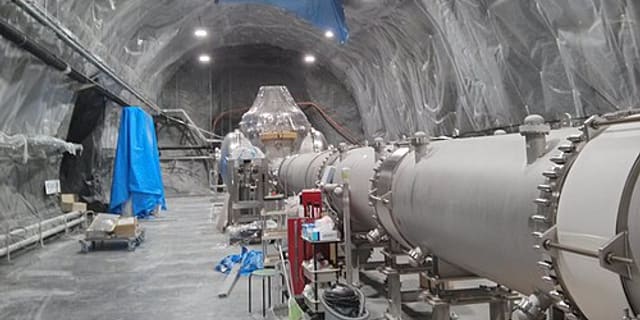
KamLAND is an electron antineutrino detector built inside the Kamioka Observatory, an underground research facility operated by the University of Tokyo. Although it sits within the Kamioka Observatory, the KamLAND project itself is run by a team from Tohoku University. The detector occupies the old KamiokaNDE cavity, a drift mine shaft that once housed an earlier generation of neutrino experiments.
Instrument & research
KamLAND is sensitive to roughly a quarter of the antineutrinos produced by nuclear fission in reactors within its detection threshold of 1.8 megaelectronvolts. Because antineutrino flux fades with distance in the same way starlight dims from a distant star, the detector's position - an average flux-weighted 180 kilometres from surrounding reactors - makes it especially useful for studying how neutrinos change, or "oscillate," between types as they travel. That sensitivity has made KamLAND an important instrument for testing solutions to the long-standing solar neutrino problem.
Location & getting there
The detector lies underground in the Kamioka district of Hida, a mountain city in Gifu Prefecture on Japan's main island of Honshu. Its location deep inside the Japanese Alps shields it from cosmic-ray background noise, and the surrounding region is dotted with the commercial nuclear reactors whose antineutrinos the detector was built to measure.
Visiting KamLAND
KamLAND is an active research instrument inside a working mine facility, not a public observatory, so there is no general walk-in access. Anyone hoping to learn more or arrange an academic visit should check the current guidance on the Tohoku University KamLAND project website before travelling.
See your named star from here
KamLAND studies particles from reactors here on Earth rather than the stars overhead, but the science of pinpointing something in the sky by its exact coordinates is a shared thread. When you name a star with Star Register, you receive the same kind of precise right ascension and declination that professional instruments use to find their targets - coordinates you can hand to any stargazing app or observatory, and explore further in our star catalogue.
Opening hours and public-visit programs vary by season. Check the official website and Google Maps for current times before you travel.
Institutional and reference sources used to verify this guide.
Satellite imagery: Esri, Maxar, Earthstar Geographics
Kamioka Observatory
underground neutrino and gravitational wave observatory in Kamioka, Japan

 1 km
1 km
 2 kmResearch