
Gauribidanur Radio Observatory

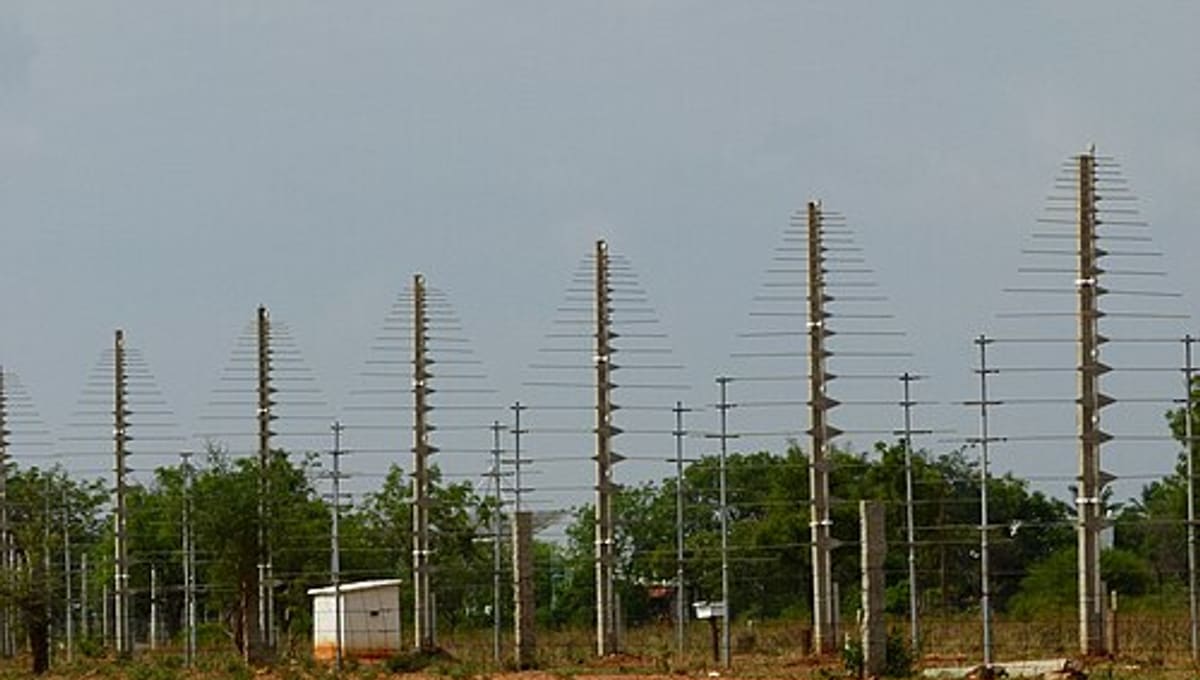
Image: Wikimedia Commons
About 80 kilometres from Bengaluru, the Gauribidanur Radio Observatory has spent nearly five decades listening to the radio signals of the Sun and distant cosmic sources.
About Gauribidanur Radio Observatory
The observatory has been operational since 1976 and is jointly run by the Raman Research Institute and the Indian Institute of Astrophysics. Its main instruments are the Gauribidanur Telescope (GEETEE), a T-shaped array of 1,000 dipoles operating at 34.5 MHz used for all-sky surveys, supernova remnants and pulsars, and the Gauribidanur Radio Heliograph (GRAPH), a 192-antenna log-periodic dipole array covering 40–150 MHz that has been running since 1997. The site also includes a 6-metre radio telescope and a high-resolution spectrograph.
Telescopes & research
Research at Gauribidanur spans solar corona observations, pulsar and neutron star studies, cosmic ray research and radio sky surveys. As recently as 2024, the observatory's work has included measuring solar magnetic fields with commercial dish TV antennas and coordinating observations with India's Aditya-L1 solar spacecraft.
Location & getting there
The observatory is located near Gauribidanur, roughly 80 km from Bengaluru, in the Asia region of India.
See your named star from here
An observatory built to catch faint radio whispers from across the galaxy is a striking place to think about your own named star. Find its coordinates in our catalogue, or name a star to begin.
Opening hours and public-visit programs vary by season. Check the official website and Google Maps for current times before you travel.
Institutional and reference sources used to verify this guide.
Satellite imagery: Esri, Maxar, Earthstar Geographics

 375 kmSolar
 569 km
 672 kmResearch
Inter-University Centre for Astronomy and Astrophysics
Indian institute for Astronomical sciences