
Kodaikanal Solar Observatory

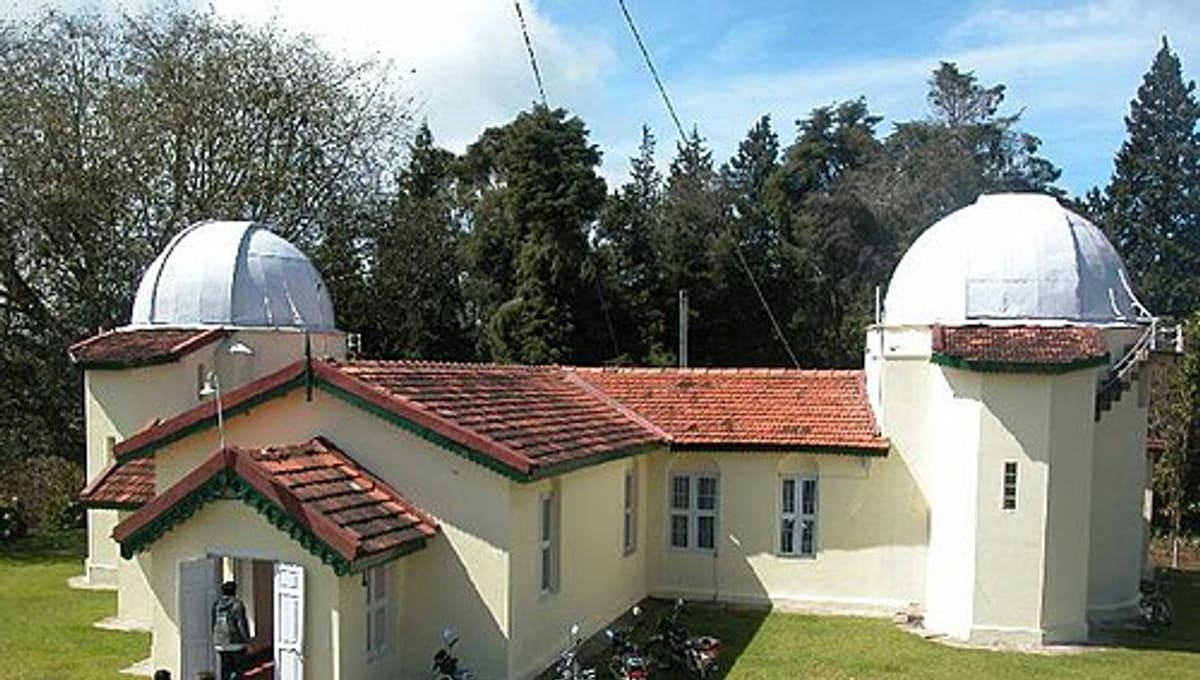
Image: Wikimedia Commons
Kodaikanal Solar Observatory sits on the southern tip of the Palani Hills, about 4 kilometres from the hill town of Kodaikanal in Tamil Nadu, India, and has watched the sun continuously since the turn of the 20th century.
About Kodaikanal Solar Observatory
Owned and operated by the Indian Institute of Astrophysics, the observatory was established following a famine in the Madras Presidency, when officials sought to understand monsoon patterns through the study of the sun. Charles Michie Smith selected the Kodaikanal site for its clear skies, low humidity, and minimal fog.
History
Equipment was transferred from the earlier Madras Observatory starting in 1895, and the observatory was formally founded on 1 April 1899. Regular observations began in 1901 under Smith's direction. In January 1909, the Evershed effect, the radial flow of gas in sunspots, was first detected here, a landmark discovery in solar physics.
Telescopes & research
Kodaikanal holds the oldest continuous series of solar data recorded anywhere in India. Beyond solar observing, the site also measures the equatorial electrojet, taking advantage of Kodaikanal's unique geography, along with ionospheric soundings, geomagnetic readings, and F region vertical drift. Data summaries are shared with national bodies like the India Meteorological Department and global organisations including the World Meteorological Organization and Global Atmosphere Watch. A full-time staff of two scientists and three technicians keeps the observations running.
Location & getting there
The observatory sits in the Palani Hills near the popular hill station of Kodaikanal in Tamil Nadu, southern India, a setting chosen over a century ago for its clean, stable atmosphere.
Visiting Kodaikanal Solar Observatory
Check the Indian Institute of Astrophysics' Kodaikanal centre website or contact them directly for current visiting arrangements before travelling.
See your named star from here
An observatory with over a century of continuous solar data is a fitting place to think about the night sky too, and a named star from Star Register gives you exact coordinates to look for. Find your star in the star catalogue.
Opening hours and public-visit programs vary by season. Check the official website and Google Maps for current times before you travel.
Institutional and reference sources used to verify this guide.
Satellite imagery: Esri, Maxar, Earthstar Geographics

 200 km
 1,005 kmResearch
Inter-University Centre for Astronomy and Astrophysics
Indian institute for Astronomical sciences