
Emerald Lane Observatory
Satellite imagery: Esri, Maxar, Earthstar Geographics
Emerald Lane Observatory is a private amateur observatory built on the roof of a home on Emerald Lane in Decatur, Alabama, where astronomer Loren C. Ball has tracked hundreds of asteroids.
About Emerald Lane Observatory
Rather than a public institution, Emerald Lane Observatory is the personal facility of amateur astronomer Loren C. Ball, born in 1948 in Watonga, Oklahoma. Registered with the Minor Planet Center under observatory code 843, it sits atop his house in Decatur, Alabama, at an elevation of about 201 meters.
Telescopes & research
Between 2000 and 2004, Ball used the observatory to discover more than 100 asteroids, earning credit for 112 numbered minor-planet designations with the Minor Planet Center at Harvard — all solo discoveries, with no co-discoverers. In recognition of his work, the main-belt asteroid 16095 Lorenball, found by the Catalina Sky Survey in 1999, was named in his honor, with the official citation published by the Minor Planet Center in November 2019. Ball is also under contract with NASA through the University of Alabama in Huntsville to bring asteroid education to school groups and community organizations.
Location & getting there
The observatory is located in Decatur, Alabama, in the southeastern United States, at roughly 201 meters above sea level. As a private residential observatory, it is not set up as a general tourist site.
Visiting Emerald Lane Observatory
Because Emerald Lane Observatory operates from a private home, it is not open for public tours. Ball's public-facing work happens instead through school and community outreach programs; anyone interested in his research is best served by checking his published pages or contacting him through his professional channels before assuming any access.
See your named star from here
Emerald Lane Observatory is a reminder that meaningful astronomy doesn't require a mountaintop — a dedicated amateur with a rooftop telescope can chart the sky in real detail. If a private setup like this can track asteroids precisely enough to earn official designations, imagine what a visit to any observatory could show you once you have the coordinates of your own named star. Browse the catalogue or explore naming a star to get started.
Opening hours and public-visit programs vary by season. Check the official website and Google Maps for current times before you travel.
Institutional and reference sources used to verify this guide.
Satellite imagery: Esri, Maxar, Earthstar Geographics

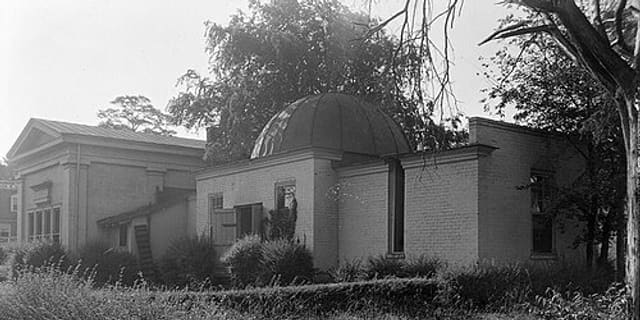 157 kmResearch
Old University of Alabama Observatory
observatory in Alabama, United States of America

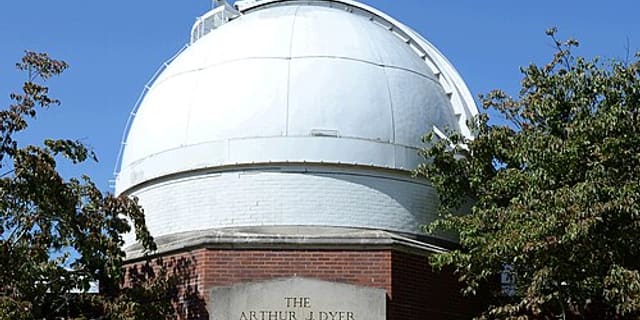 170 kmResearch
Dyer Observatory
Vanderbilt University observatory in Brentwood, Tennessee

 239 kmResearch
 239 km