
Kennon Observatory

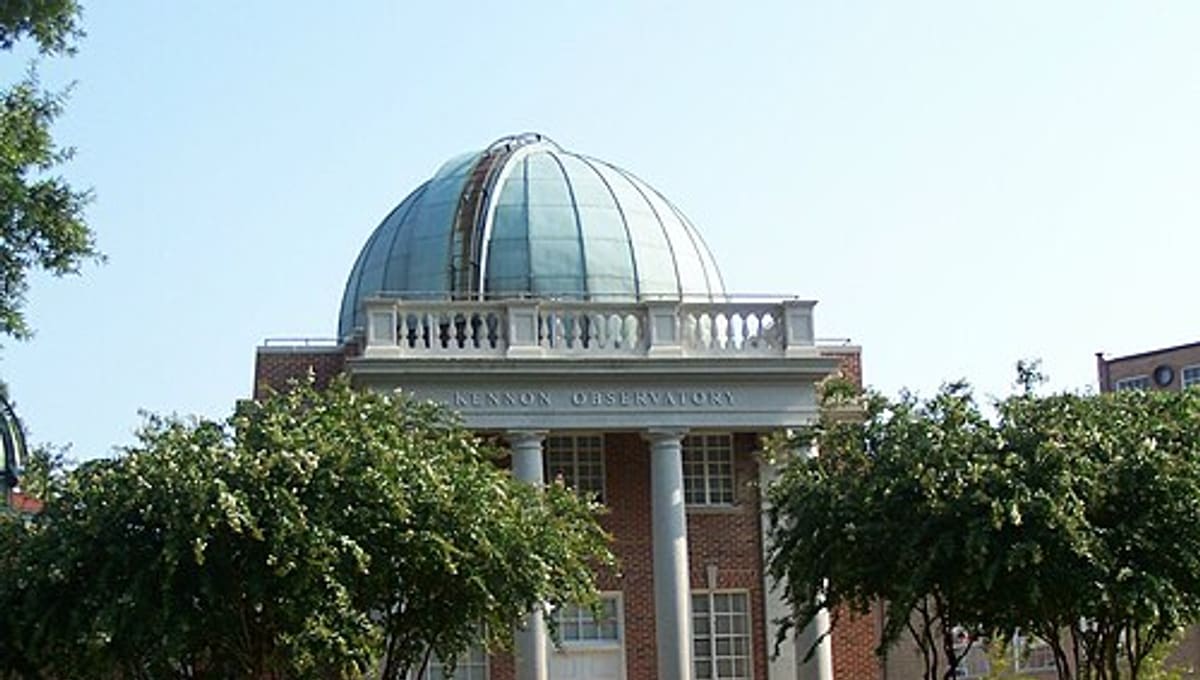
Image: Wikimedia Commons
Kennon Observatory has stood on the University of Mississippi campus in Oxford, Mississippi since 1939, its twin copper-roofed domes a familiar landmark for generations of students and stargazers.
About Kennon Observatory
The observatory is owned and operated by the University of Mississippi's Department of Physics and Astronomy. It is named after William Lee Kennon, who chaired the department for many years. The building has two copper domes and a main entrance facing south, with the whole structure precisely aligned east to west — a deliberate design choice tied to its astronomical function.
History
Kennon Observatory was constructed in 1939 as part of the federal Public Works Administration building programme that ran from 1936 to 1941. In 2011 it was designated a Mississippi Landmark in recognition of its architectural and institutional history. One of its more charming details is a small tube built into the south wall, positioned so that direct sunlight only reaches the floor twice a year, at noon on the vernal and autumnal equinoxes.
Telescopes & research
The observatory houses several instruments, including a 15-inch telescope, a 5-inch telescope, and a 3-inch telescope in its transit room, supporting both teaching and public observing.
Location & getting there
Kennon Observatory is easy to find on the University of Mississippi's Oxford campus, in the heart of north-central Mississippi.
Visiting Kennon Observatory
The university holds regular Open House events at Kennon Observatory, giving the public a chance to look through its historic telescopes. Check the university's event calendar for current dates before visiting.
See your named star from here
During an open house at Kennon Observatory, the resident telescopes can be aimed at the exact right ascension and declination of any named star. Name a star for someone special, then find its position in our catalogue to look for it here.
Opening hours and public-visit programs vary by season. Check the official website and Google Maps for current times before you travel.
Institutional and reference sources used to verify this guide.
Satellite imagery: Esri, Maxar, Earthstar Geographics

 under 1 kmResearch
 224 kmResearch
Old University of Alabama Observatory
observatory in Alabama, United States of America
River Ridge Observatory
astronomical observatory in Arkansas, United States