
Corralitos Observatory
Satellite imagery: Esri, Maxar, Earthstar Geographics
Corralitos Observatory was a historic astronomical research station in the Rough and Ready Hills, about 30 kilometres west of Las Cruces, New Mexico, that operated for several decades in the second half of the 20th century.
About Corralitos Observatory
The observatory was formally dedicated on October 12, 1965, serving as a remote station of Dearborn Observatory, Northwestern University. It was mainly staffed by students of New Mexico State University over its operating life.
History
From October 1965, staff ran a NASA-sponsored program to detect transient lunar phenomena, logging 6,466 hours of lunar observation through 1972 without confirming any. In 1966 a specialized Schmidt wide-angle camera, sponsored by Chrysler, was installed as a test model for a far ultraviolet camera intended for the Apollo spacecraft, possibly the first operational camera of its type. During the 1970s the observatory ran one of the first semi-automated supernova search programs, using its 0.6 m and 0.3 m Cassegrain telescopes to find ten supernovae. On April 14, 1970, observers there are believed to have been the only ones to photograph the in-flight explosion aboard Apollo 13 as it approached the Moon, and in 1971 a photograph of the Apollo 14 spacecraft separating from its S-IVB rocket stage was also taken from the site. Funding shortfalls halted operations in 1978, and the observatory was transferred to the Corralitos Astronomical Research Association in 1981. It was still monitoring faint Be stars as of 1997, but no activity has been recorded since its association's website went offline in 2012.
Telescopes & research
At its most active, the site housed 0.6 m and 0.4 m Cassegrain telescopes, a 0.3 m Cassegrain used for photometry, and the 0.152 m Chrysler-sponsored Schmidt camera.
Location & getting there
Corralitos Observatory sits in the Rough and Ready Hills of southern New Mexico, roughly 30 kilometres west of Las Cruces, in the high desert country typical of the region.
Visiting Corralitos Observatory
Corralitos Observatory does not appear to be an active public facility today; its operating association's website has been offline since 2012, and there is no record of current tours or opening hours. Anyone interested in the site's present status should search for recent information before planning a visit, or look instead to an active observatory in the Las Cruces area.
See your named star from here
Even though Corralitos itself is no longer publicly operating, the same idea applies at any working observatory: give staff the right ascension and declination from your star naming certificate, and they can point a telescope right at it. Look up your star in the star catalogue to get started.
Opening hours and public-visit programs vary by season. Check Google Maps for current times before you travel.
Institutional and reference sources used to verify this guide.
Satellite imagery: Esri, Maxar, Earthstar Geographics

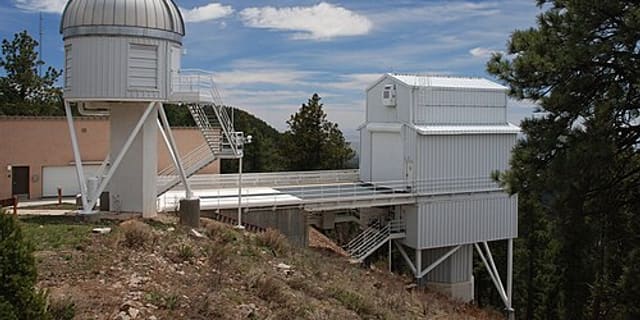 123 km
Apache Point Observatory
astronomical observatory in Sunspot, New Mexico, United States

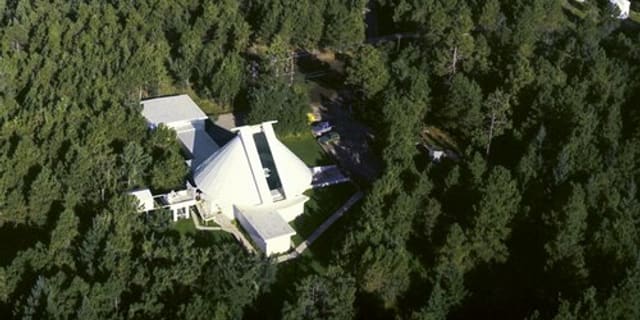 123 kmSolar
Sunspot Solar Observatory
astronomical observatory in Sunspot, New Mexico, United States

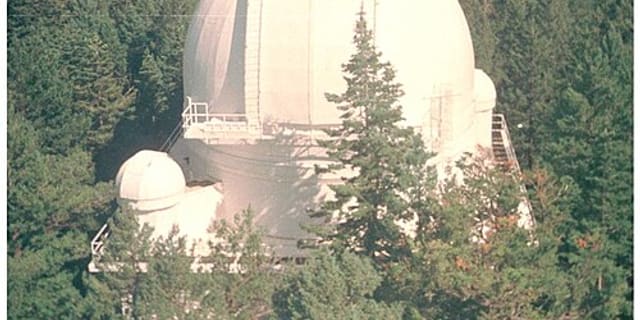 140 km