
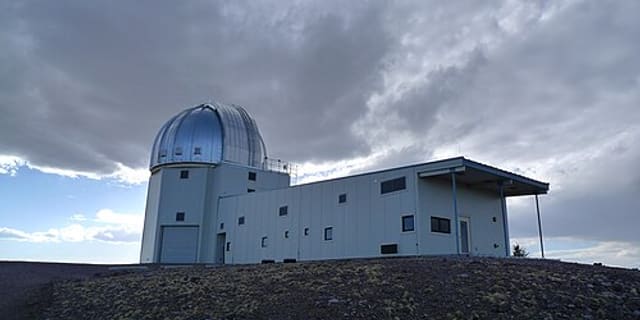
NF observatory
Satellite imagery: Esri, Maxar, Earthstar Geographics
NF Observatory sits in Grant County, New Mexico, near Silver City, where clear skies for more than 200 nights a year have supported decades of asteroid, supernova, and variable star research.
About NF Observatory
NF Observatory is a non-profit scientific organisation located in Grant County, New Mexico, at an elevation above 6,000 feet. Its high, dry site benefits from over 200 clear observing nights per year, a rare advantage for a working research observatory.
History
The observatory's first instrument, a 17-inch telescope, was designed and built in 1987 and went on to operate unattended for more than a decade. Its original CCD camera was custom-built from component parts, using a CCD chip loaned by NASA's Jet Propulsion Laboratory. In the summer of 2001, the observatory added a second, larger instrument: a 24-inch telescope on a Group 128 mount, relocated from the University of Arkansas at Little Rock.
Telescopes & research
From 1987 through at least 1997, NF Observatory's research focused on supernovae, asteroids, galaxies, and variable stars, work carried out largely with its original 17-inch telescope before the 24-inch instrument joined it. The observatory also administers Project ASTRO - New Mexico, a partnership program that pairs astronomers with teachers for education outreach.
Location & getting there
The observatory is located in Grant County, near Silver City, New Mexico, part of the North America region, in the high desert terrain that gives the site its exceptionally clear, dark skies.
Visiting NF Observatory
Further information is available on the observatory's official website, nfo.edu; as a research and education-focused non-profit, it is worth checking there for current details on tours, programs, or visiting access.
See your named star from here
With more than 200 clear nights a year, NF Observatory's telescopes are well placed to seek out faint objects at precise coordinates, exactly the kind of right ascension and declination that comes with every star named through Star Register. Browse the catalogue to find a star, or choose a naming package to name one yourself.
Opening hours and public-visit programs vary by season. Check Google Maps for current times before you travel.
Institutional and reference sources used to verify this guide.
Satellite imagery: Esri, Maxar, Earthstar Geographics
Dark Sky New Mexico observatory
astronomical observatory in New Mexico, United States

 163 km
Experimental Test Site
MIT Lincoln Laboratory field site located in Socorro, New Mexico