
Blue Mesa Observatory
Satellite imagery: Esri, Maxar, Earthstar Geographics
High on Magdalena Peak in the Sierra de las Uvas of southern New Mexico, Blue Mesa Observatory served New Mexico State University's astronomy programme for over two decades before its telescope moved on to a new home.
About Blue Mesa Observatory
Blue Mesa Observatory (BMO), also known as the Magdalena Peak Station for the International Planetary Patrol Program, was an astronomical observatory owned and operated by New Mexico State University (NMSU). It stood on Magdalena Peak in the Sierra de las Uvas, about 43 km (27 miles) northwest of Las Cruces.
History
Founded in 1967 under the supervision of Clyde Tombaugh, the discoverer of Pluto, BMO served NMSU students, faculty and visitors from 1969 through 1991. The Federal Aviation Administration's 1991 offer to use the site for a radar installation, combined with the growing importance of NMSU's Apache Point facilities, led the university to close and consolidate its observing programme, and BMO shut down in 1993. The FAA later demolished the original observatory building and replaced it with radar equipment.
Telescopes & research
BMO's main instrument was a 0.61 m (24 in) Cassegrain reflector built by Astro Mechanics and installed in 1969, equipped with a Boller and Chivens spectrograph, a spectrophotometer and a photoelectric photometer. After the observatory closed, Pittsburg State University acquired the telescope and instruments in 1993 and installed them at its PSU-Greenbush Astrophysical Observatory near Girard, Kansas, in 1996, where they remain in use today.
Location & getting there
The former site sits atop Magdalena Peak in the Sierra de las Uvas (Grape Mountains) of southern New Mexico, northwest of Las Cruces. It is now occupied by an FAA radar installation and is not open to visitors.
Visiting Blue Mesa Observatory
Blue Mesa Observatory no longer exists as a public site: the original building was torn down after the FAA took over the location. Its telescope lives on at the PSU-Greenbush Astrophysical Observatory in Kansas, which anyone curious about the instrument's history could look into instead.
See your named star from here
Although the mountaintop itself is off-limits, the observing tradition BMO started continues elsewhere. After you name a star, check its coordinates in the catalogue and look through our observatories directory for a working telescope near you that can seek it out.
Opening hours and public-visit programs vary by season. Check Google Maps for current times before you travel.
Institutional and reference sources used to verify this guide.
Satellite imagery: Esri, Maxar, Earthstar Geographics

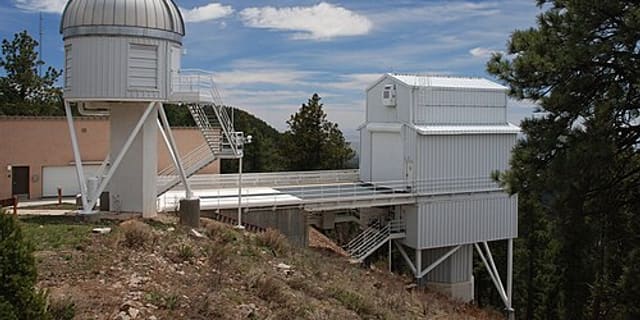 130 km
Apache Point Observatory
astronomical observatory in Sunspot, New Mexico, United States

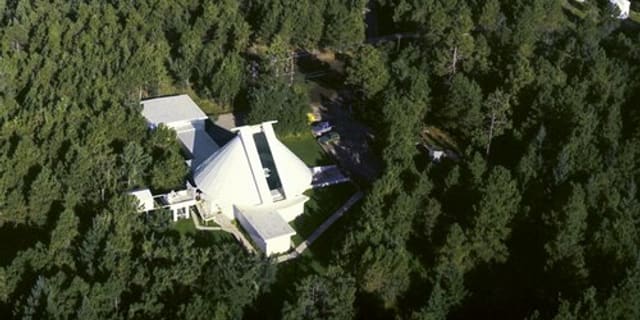 130 kmSolar
Sunspot Solar Observatory
astronomical observatory in Sunspot, New Mexico, United States

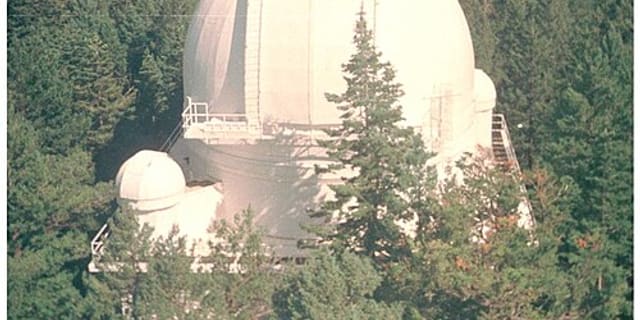 145 km