
Tāhuna Glenorchy Dark Sky Sanctuary

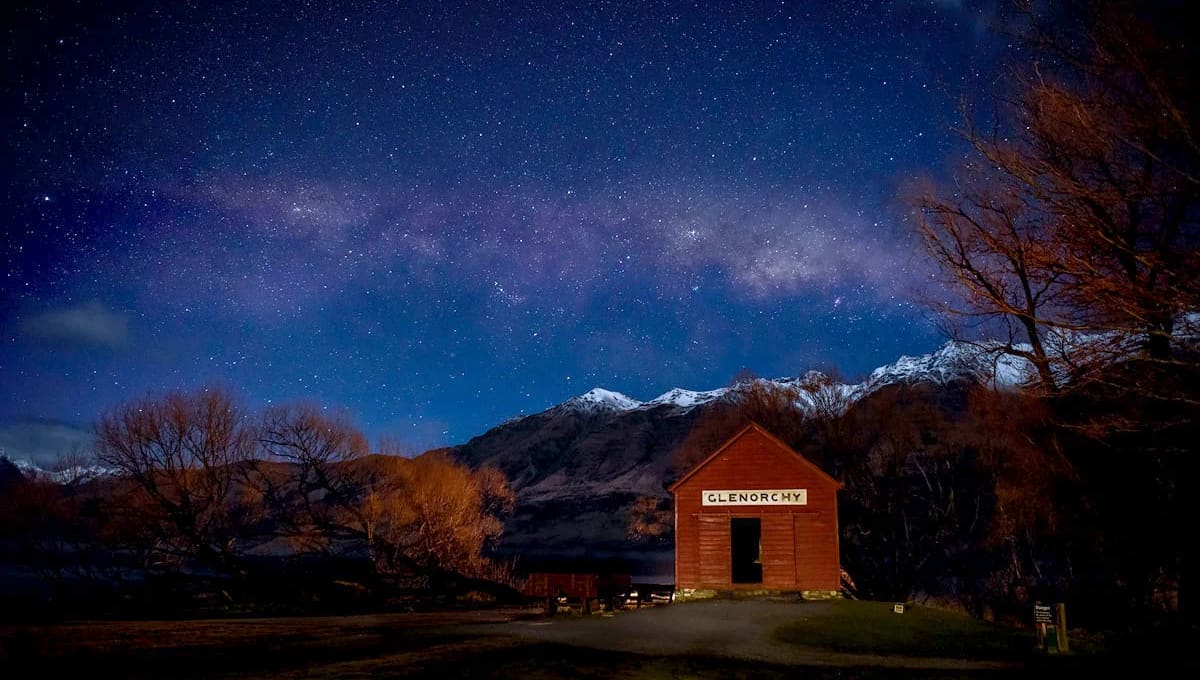
Image: GyCGDavis · CC BY-SA 4.0 · Wikimedia Commons
The Tāhuna Glenorchy Dark Sky Sanctuary spans roughly 200,000 hectares at the head of Lake Wakatipu in the Queenstown-Lakes District of New Zealand's South Island, reaching from Bennett's Bluff on the Queenstown-Glenorchy road into a large portion of Mount Aspiring National Park. On 4 February 2025 it became the 23rd International Dark Sky Sanctuary in the world, and the first of its kind set inland among mountains.
Why Tāhuna Glenorchy is a top stargazing spot
Around 75% of the sanctuary lies within the Te Wāhipounamu World Heritage area, and it sits on the 45th parallel south, the same latitude as the Atacama Desert and other renowned dark-sky sites. Its skies measure Bortle Class 2, with sky quality readings around 21.61 magnitudes per square arcsecond, genuinely dark by any measure. The sanctuary encompasses the Greenstone-Caples, Routeburn and Rees-Dart walking tracks, giving visitors dark skies across a huge stretch of protected mountain wilderness.
What you can see
Visitors describe the Milky Way here as a river weaving across the sky, and the aurora australis, the Southern Lights, is often visible and reflected in the still waters of Lake Wakatipu, with the wharf at Glenorchy a popular spot to watch for it. Planets appear as bright, steady beacons when viewed from the surrounding mountain peaks. The sanctuary's location also gives it a rare vantage point for the total solar eclipse expected in 2028.
Visiting Tāhuna Glenorchy at night
On 30 November 2024 the area was designated the first Winterstellar Astronomical Site, recognising its year-round stargazing appeal. Beyond looking up, visitors can join horse trekking or kayak out to the sanctuary's remote islands by day, then watch for the aurora from the Glenorchy wharf after dark. A local Dark Skies Group is currently raising funds to expand the protected area to include the Glenorchy and Kinloch communities, and 2025 brought new initiatives including a planned star compass art installation to share traditional star lore and a Year of the Moth programme focused on the region's nocturnal wildlife. Check the Glenorchy Dark Skies site for current visiting information and any scheduled events.
Best time to go
As a Southern Hemisphere site, Tāhuna Glenorchy has its Milky Way core season roughly from February to October, when the galactic centre climbs high overhead after dark. Winter brings the longest, darkest nights and the best odds of an aurora sighting, while meteor watchers can look out for the Geminids in December and the Quadrantids in January. Whatever month you visit, a new-Moon night and twenty to thirty minutes to let your eyes dark-adapt will give you the clearest view of the Milky Way's river of stars.
Getting there
Glenorchy sits at the head of Lake Wakatipu, reached along the scenic Glenorchy-Queenstown Road that hugs the lake's edge; it is the last settlement before the sanctuary's wilderness tracks and mountain terrain begin.
See your named star from here
Skies dark enough to show the Milky Way as a river and reflect the aurora in a mountain lake are an extraordinary place to find a star you've named through Star Register. Bring your certificate's coordinates and a stargazing app, look up the star in our catalogue beforehand, or begin with our packages; browse more certified dark-sky sites on our observatories page.
Conditions and access vary by season. Check the official website and Google Maps before you travel, and aim for a clear night near the new Moon for the darkest sky.
Satellite imagery: Esri, Maxar, Earthstar Geographics

 65 kmPreserve
 148 kmPreserve
 175 kmReserve
 262 kmSanctuary
Stewart Island/Rakiura International Dark Sky Sanctuary
dark sky sanctuary in New Zealand