
Uppsala Magnetic Observatory
Satellite imagery: Esri, Maxar, Earthstar Geographics
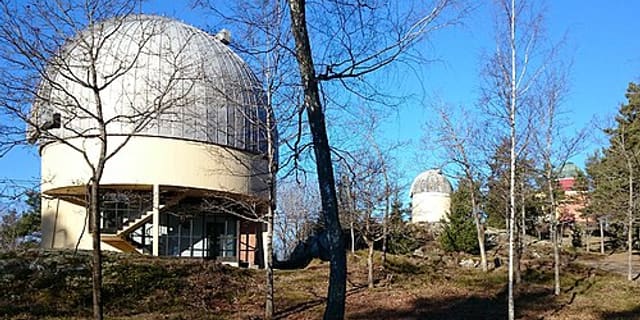
West of Uppsala, Sweden, the Uppsala Magnetic Observatory continues a tradition of geomagnetic research that stretches back to the 18th century.
About Uppsala Magnetic Observatory
Run today by SGU, the Geological Survey of Sweden, the observatory continuously records variations in the Earth's magnetic field. It is one of a small Swedish network that also includes stations at Abisko and Lycksele, and its data is used for magnetic instrument development and calibration.
History
The site's story begins with Anders Celsius, who ordered a large compass and studied the directions of magnetic field variation in Uppsala. In the winter of 1741, Celsius and his assistant Hiorter observed unusual behaviour in a magnetic needle that coincided with the northern lights, an early clue linking the aurora to Earth's magnetism. Later, Gustaf Svanberg carried out geomagnetic measurements at Uppsala, inspired by the Magnetic Association founded by Gauss and Weber in Göttingen. Together, these observations helped lay the groundwork for understanding the connection between solar activity and Earth's magnetic field.
Location & getting there
The observatory sits just west of Uppsala, Sweden, part of a wider network of Swedish geomagnetic monitoring stations.
Visiting Uppsala Magnetic Observatory
As a technical monitoring station, it isn't set up for general public visits; check with SGU for any current information before travelling.
See your named star from here
This site watches Earth's magnetic field rather than the stars, but Uppsala's own astronomical observatory, with research reaching back to Anders Celsius's era, is close by. Once you've named a star with Star Register, use our catalogue to find its coordinates and view it from a telescope elsewhere in the region.
Opening hours and public-visit programs vary by season. Check Google Maps for current times before you travel.
Institutional and reference sources used to verify this guide.
Satellite imagery: Esri, Maxar, Earthstar Geographics

 47 kmMuseum
 74 kmMuseum