
Sandvreten Observatory
Satellite imagery: Esri, Maxar, Earthstar Geographics
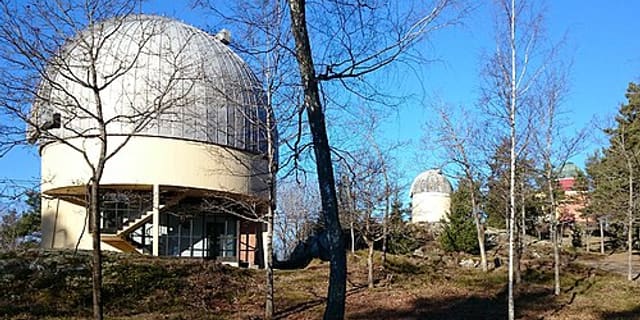
On a small hill outside Uppsala, Sweden, Sandvreten Observatory has spent more than four decades gathering precise brightness measurements of stars and searching for the tell-tale dips of transiting exoplanets.
About Sandvreten Observatory
Sandvreten Observatory was founded around 1981-82 and built to support serious amateur photometry, measuring exactly how bright stars are and how that brightness changes over time. Several telescope mounts share the hilltop site, allowing observations to be carried out both remotely and in person.
Telescopes & research
The observatory's main instrument is a 0.444-metre f/4.4 Newtonian telescope, fitted with an SBIG ST-7E dual CCD camera and a set of Johnson-Cousins BVRI photometric filters. That combination lets observers record precise, colour-calibrated brightness data, which has been used for photometric studies including the timing of exoplanet transits.
Location & getting there
Sandvreten sits just outside Uppsala in central Sweden, a university city whose surrounding countryside offers darker skies than nearby Stockholm. The hilltop setting was chosen to keep the horizon clear for both remote and on-site observing runs.
Visiting Sandvreten Observatory
As an active amateur research site, Sandvreten does not run regular public visiting hours; anyone interested in its photometric work should check with the operating astronomy group or look for open-sky events before planning a visit.
See your named star from here
The same photometric telescopes used to catch an exoplanet transit at Sandvreten can just as easily be pointed at the coordinates of a star named through Star Register. Explore the star catalogue to see what's out there.
Opening hours and public-visit programs vary by season. Check Google Maps for current times before you travel.
Institutional and reference sources used to verify this guide.
Satellite imagery: Esri, Maxar, Earthstar Geographics

 40 kmMuseum
 70 kmMuseum
 86 km
86 km