
Tokyo-Norikura observatory

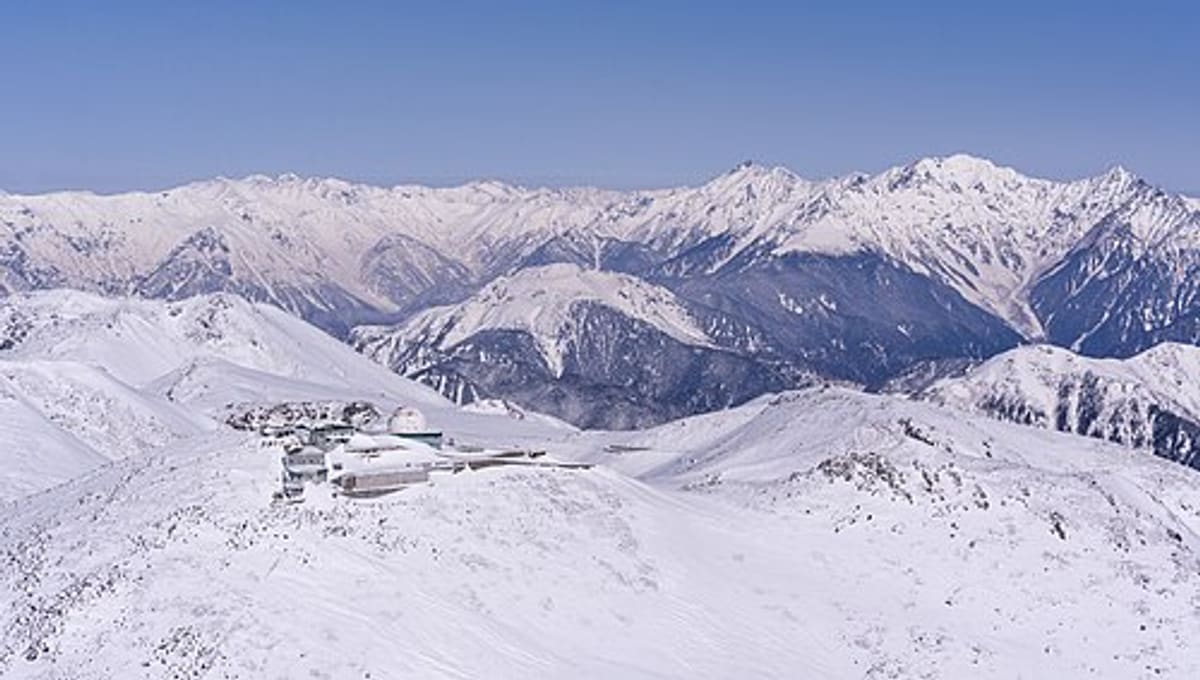
Image: Wikimedia Commons
Tokyo-Norikura Observatory occupies a high-altitude perch on Mount Norikura in Gifu Prefecture, Japan, where thin mountain air and clear skies have supported solar and cosmic-ray research for over seventy years.
About Tokyo-Norikura Observatory
Founded in 1949 as the first off-campus facility of the Tokyo Astronomical Observatory (University of Tokyo), the site was established as the Norikura Solar Observatory. It also functions as a Cosmic Ray Observatory, formally set up in August 1953 under the Institute for Cosmic Ray Research (ICRR), University of Tokyo, and remains one of ICRR's primary facilities today.
History
The observatory's dual mission — solar physics and cosmic-ray research — dates back to its founding years in the late 1940s and early 1950s, a period when Japanese universities were building out mountain-top stations to study phenomena best observed away from lowland haze and light.
Telescopes & research
The site operates coronagraphs for studying the Sun's corona, alongside instrumentation for cosmic-ray studies, including particle and nuclear interactions in ultra-high energy regions and solar neutron observation. This combination of solar and particle astrophysics is relatively unusual for a single mountain station.
Location & getting there
Tokyo-Norikura Observatory sits at an elevation of roughly 2,770–2,876 metres on Mount Norikura in the Northern Japan Alps, near Nyukawa-cho in Takayama City, Gifu Prefecture (about 36.11°N, 137.55°E). The altitude and remoteness that make it valuable for research also make it a demanding site to reach.
Visiting Tokyo-Norikura Observatory
As a working research station at high altitude, access is more limited than at lowland public observatories. Anyone hoping to visit should check current arrangements with ICRR or the University of Tokyo before planning a trip.
See your named star from here
A telescope can be aimed at any coordinates on the sky, so researchers working at a high-altitude site like Norikura could, in principle, locate your named star's right ascension and declination on a clear night. Explore our star-naming packages or browse the star catalogue to find the star named for you.
Opening hours and public-visit programs vary by season. Check Google Maps for current times before you travel.
Institutional and reference sources used to verify this guide.
Satellite imagery: Esri, Maxar, Earthstar Geographics

 under 1 kmRadio
 40 km
40 kmKamioka Liquid Scintillator Antineutrino Detector
neutrino oscillation experiment in Japan