
Robotic Optical Transient Search Experiment
Satellite imagery: Esri, Maxar, Earthstar Geographics
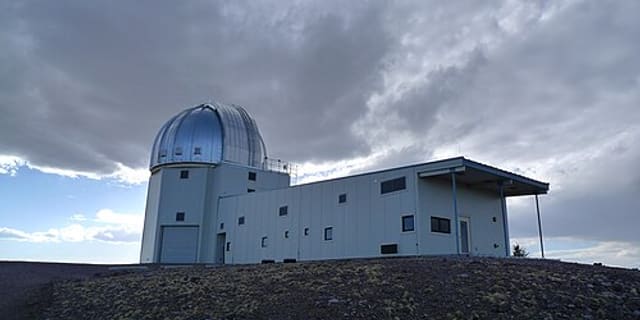
The Robotic Optical Transient Search Experiment, known as ROTSE, is a multi-telescope experiment built to catch the fleeting optical afterglow of gamma-ray bursts, with one of its telescopes located at the McDonald Observatory near Fort Davis, Texas.
About ROTSE
Rather than a single site, ROTSE is a network: it currently runs four telescopes spread across Australia, Namibia, Turkey, and the United States, with the Namibian instrument sited at the High Energy Stereoscopic System location in the Gamsberg mountains south-west of Windhoek. The project brings together astrophysicists from the University of Michigan, Los Alamos National Laboratory, Lawrence Livermore National Laboratory, the University of New South Wales, and Germany's Max Planck Institute for Nuclear Physics.
History
The original ROTSE-I used four telephoto lenses of 11 cm aperture covering a wide 16-by-16-degree field of view, wide enough that it captured the first-ever recorded optical afterglow of a gamma-ray burst while the burst itself was still ongoing. A planned ROTSE-II was never built once newer satellites like HETE-2 and Swift began providing more precise burst locations, making such a huge field of view unnecessary. That shift led to ROTSE-III, a more conventional telescope design built for fast slewing and operation at multiple sites worldwide.
Location & getting there
ROTSE's U.S. telescope operates at the McDonald Observatory near Fort Davis, Texas, one node in a network that spans four continents' worth of dark-sky sites.
Visiting ROTSE
ROTSE's telescopes are automated research instruments rather than public attractions; visiting hours and access are set by each host observatory, such as McDonald Observatory in Texas, rather than by the ROTSE collaboration itself.
See your named star from here
A global network built to catch bursts of light across the sky is a good reminder that any point on the celestial sphere, including a named star's coordinates, can be found from the right telescope. Browse the naming packages or the catalogue.
Opening hours and public-visit programs vary by season. Check Google Maps for current times before you travel.
Institutional and reference sources used to verify this guide.
Satellite imagery: Esri, Maxar, Earthstar Geographics

 217 km
Experimental Test Site
MIT Lincoln Laboratory field site located in Socorro, New Mexico