
Calvin-Rehoboth Robotic Observatory
Satellite imagery: Esri, Maxar, Earthstar Geographics
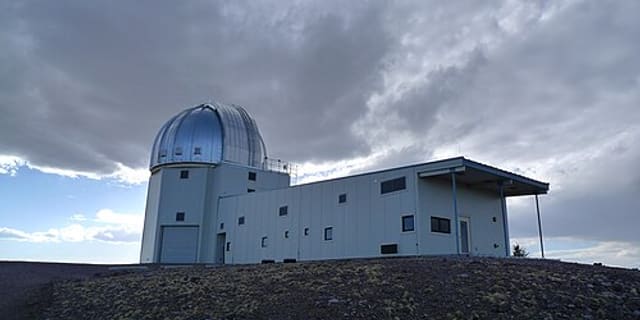
The Calvin–Rehoboth Robotic Observatory sits on the campus of Rehoboth Christian School in northwestern New Mexico, one half of a two-site observatory built jointly with Calvin University in Michigan. Its remote-controlled telescope has been quietly contributing to real astronomical discoveries since 2004.
About Calvin–Rehoboth Robotic Observatory
The observatory (assigned the Minor Planet Center observatory code G98) pairs identical telescopes on the two school campuses. Because cloud cover often interferes with observing in Michigan, Calvin University students train on their home instrument and then log in remotely to operate the twin telescope in the clearer New Mexico skies above Rehoboth.
History
The joint program has been running since 2004, giving both college and high school students hands-on access to research-quality equipment that would otherwise be out of reach for a small school.
Telescopes & research
Students using the observatory have discovered several minor planets, including 145475 Rehoboth, named for the New Mexico school that hosts this telescope, and 134244 De Young, named for a former Rehoboth Christian School science teacher. The New Mexico site also hosts star parties and visual sessions for student groups and volunteers.
Location & getting there
The observatory is set on the Rehoboth Christian School campus in a rural stretch of northwestern New Mexico, part of the wider high-desert region prized by astronomers for its dark, dry skies.
Visiting Calvin–Rehoboth Robotic Observatory
As a working school facility rather than a public attraction, the observatory is not open on a drop-in basis. Star parties and visual sessions are arranged for student groups, staff, and volunteers through Rehoboth Christian School; anyone hoping to visit should contact the school directly before planning a trip.
See your named star from here
Because a named star is defined by its coordinates rather than its location, a telescope operator here could, in principle, point toward the same patch of sky as any star named through Star Register. Browse the star catalogue to see how your own named star's position is recorded.
Opening hours and public-visit programs vary by season. Check Google Maps for current times before you travel.
Institutional and reference sources used to verify this guide.
Satellite imagery: Esri, Maxar, Earthstar Geographics

 218 km
Experimental Test Site
MIT Lincoln Laboratory field site located in Socorro, New Mexico
Anderson Mesa Station
astronomical observatory in Coconino County, Arizona, United States of America