
Anderson Mesa Station
Satellite imagery: Esri, Maxar, Earthstar Geographics
Anderson Mesa Station is a dark-sky research site operated by Lowell Observatory, set on a high mesa southeast of Flagstaff, Arizona.
About Anderson Mesa Station
Established in 1959 as a dedicated dark-sky observing site for Lowell Observatory, Anderson Mesa Station sits about 12 miles (19 km) southeast of Lowell's historic Mars Hill campus in Flagstaff. It was created specifically because the growing city lights around the main campus were beginning to interfere with sensitive observations.
Telescopes & research
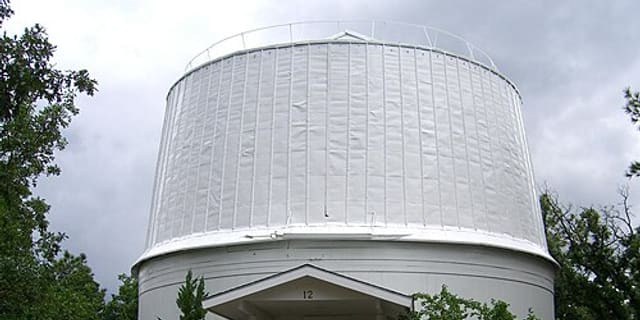
The site hosts several serious research instruments, including the 1.8-metre (72-inch) Perkins Telescope and the 1.1-metre (42-inch) John S. Hall Telescope. The 0.79-metre (31-inch) telescope of the National Undergraduate Research Observatory (NURO) has operated there since 1964, and Lowell is a partner in the Navy Precision Optical Interferometer (NPOI), run jointly with the U.S. Naval Observatory and Naval Research Laboratory, also based at Anderson Mesa. A 0.6-metre Schmidt camera formerly supported the Lowell Observatory Near-Earth-Object Search (LONEOS) survey until that project ended in 2008.
Location & getting there
The station sits at an elevation of roughly 2,163 metres in Coconino County, Arizona, chosen precisely for its remoteness from urban light pollution. Its high, dry, forested setting on the Colorado Plateau is typical of the region's excellent astronomical conditions.
Visiting Anderson Mesa Station
Anderson Mesa is a working research site rather than a public visitor centre, and it is not generally open to drop-in visitors. Public tours, exhibits and telescope viewing with Lowell Observatory take place at the main Mars Hill campus in Flagstaff; anyone interested in visiting should check Lowell Observatory's official website for current programmes.
See your named star from here
With research-grade telescopes like the Perkins and John S. Hall instruments nearby, Flagstaff's dark-sky region is one of the best places in North America to imagine your own named star being observed. If you've named a star through Star Register, its coordinates are recorded in the star catalogue, ready to share with observatory staff or a local astronomy club equipped to find it.
Opening hours and public-visit programs vary by season. Check the official website and Google Maps for current times before you travel.
Institutional and reference sources used to verify this guide.
Satellite imagery: Esri, Maxar, Earthstar Geographics

 17 km
17 kmDesert Beaver Observatory
a private astronomical observatory near Eloy, Arizona