
Robotic Lunar Observatory
Satellite imagery: Esri, Maxar, Earthstar Geographics
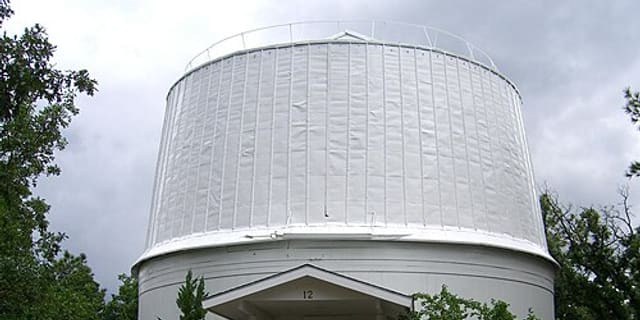
The Robotic Lunar Observatory (ROLO) is a NASA-funded facility atop McMillan Mesa at the United States Geological Survey's Flagstaff Science Campus in Flagstaff, Arizona.
About Robotic Lunar Observatory
ROLO was built with an unusual purpose: turning the Moon itself into a stable radiometric calibration reference for Earth-orbiting remote-sensing satellites, using its steady, predictable brightness to check that spacecraft instruments were measuring light accurately.
History
Founded in 1995, the observatory's visible and near-infrared (VNIR) camera began operations that same year, with a short-wavelength infrared (SWIR) camera following in 1997. The project ceased regular observations in September 2003, though the facility has been maintained since for calibration and instrument characterisation work.
Telescopes & research
ROLO consists of two 20 cm (7.9-inch) Ritchey-Chrétien telescopes mounted on a single equatorial mount built by DFM Engineering, one tuned to visible and near-infrared wavelengths and the other to short-wavelength infrared, allowing simultaneous observation of the Moon across different parts of the spectrum.
Location & getting there
The observatory sits atop McMillan Mesa within the USGS Flagstaff Science Campus in Flagstaff, Arizona, a city already well known in astronomy circles for its dark-sky protections.
Visiting Robotic Lunar Observatory
As a government research facility rather than a public attraction, ROLO does not run general visitor programmes; those interested should check the USGS Flagstaff Science Campus or the project's own site, moon-cal.org, for any current access details.
See your named star from here
A facility built to measure light from the Moon with such precision is a fitting reminder of how exactly a star's coordinates can be tracked down. Explore the naming packages or the catalogue of named stars.
Opening hours and public-visit programs vary by season. Check Google Maps for current times before you travel.
Institutional and reference sources used to verify this guide.
Satellite imagery: Esri, Maxar, Earthstar Geographics

 3 km
3 kmAnderson Mesa Station
astronomical observatory in Coconino County, Arizona, United States of America