
Neil Armstrong Observatory
Satellite imagery: Esri, Maxar, Earthstar Geographics
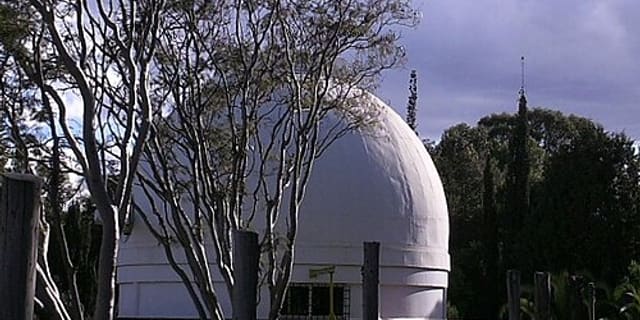
At the Pierre and Marie Curie School in Managua, Nicaragua, the Neil Armstrong Observatory gives students and researchers a dedicated dome for studying the night sky.
About Neil Armstrong Observatory
Completed on 1 March 2014 at a cost of around half a million US dollars, the observatory is named after Neil Armstrong in honour of the first person to walk on the Moon during the Apollo 11 mission in 1969. It is described as the only astronomical observatory in Latin America reserved specifically for use by scholars.
Telescopes & research
The observatory's main instrument is an 11-inch telescope capable of magnifying stellar objects between 50 and 800 times. The building itself spans two floors beneath a dome of more than 4.5 square metres: the ground floor houses a chemistry laboratory named for Irène Joliot-Curie, while the upper floor is dedicated to physics and named for Isaac Newton.
Location & getting there
The observatory is located at the Pierre and Marie Curie School in Managua, Nicaragua's capital, making it accessible as part of a visit to the city.
Visiting
As a school-based facility reserved for scholarly use, access for the general public is limited. Check with the Pierre and Marie Curie School directly for current visiting arrangements.
See your named star from here
An 11-inch telescope is more than capable of tracking down the coordinates that come with a Star Register certificate. Browse the star catalogue or see our naming packages to name a star of your own.
Opening hours and public-visit programs vary by season. Check Google Maps for current times before you travel.
Institutional and reference sources used to verify this guide.
Satellite imagery: Esri, Maxar, Earthstar Geographics

 1,413 km
 1,507 km
 1,612 km