
Quito Astronomical Observatory

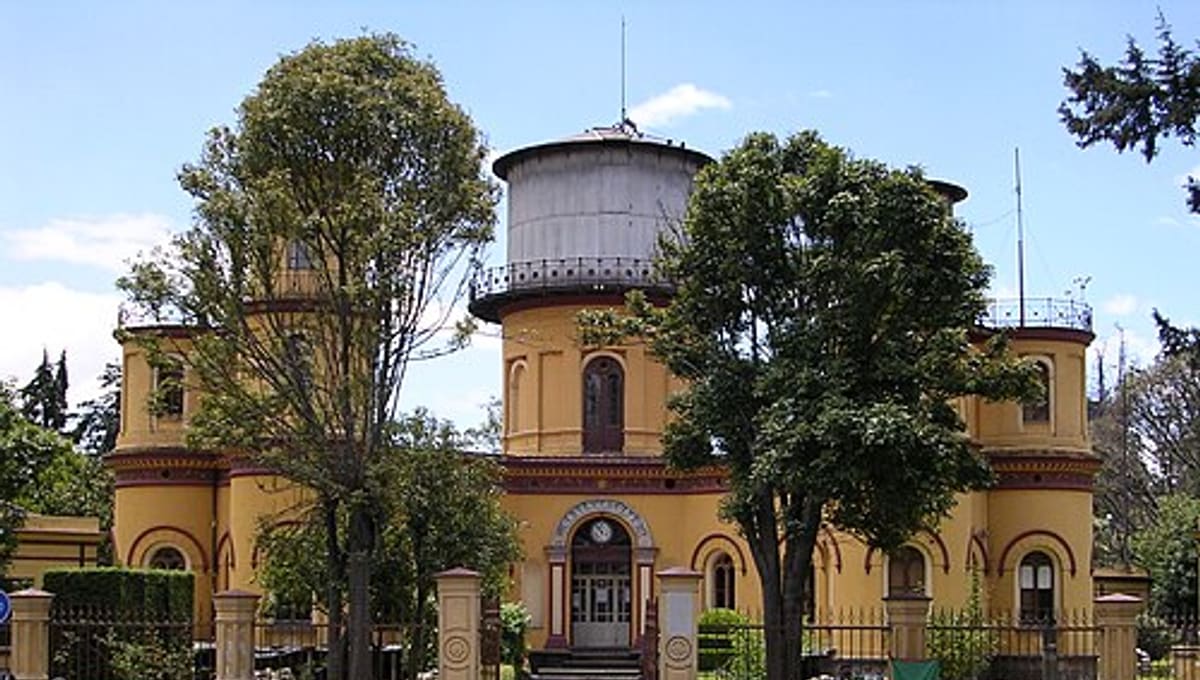
Image: Wikimedia Commons
In the historic heart of Quito, Ecuador, just minutes south of the equator, the Quito Astronomical Observatory has been watching the sky since 1873 – making it one of the oldest observatories in South America.
About Quito Astronomical Observatory
The Quito Astronomical Observatory (Observatorio Astronómico de Quito, OAQ) is a research institute of the National Polytechnic School (EPN), focused on astronomy and atmospheric physics. It is Ecuador's National Observatory, sitting in La Alameda Park in Quito's historic centre.
History
The observatory was founded in 1873 by decree of President Gabriel García Moreno, who personally laid its first stone. Its building was completed in 1878 and modelled on Bonn Observatory in Germany, with six small cylindrical domes around a central dome. The Ecuadorian government transferred the observatory to the National Polytechnic School in 1963, and a complete restoration was carried out in 2009.
Telescopes & research
Its main historic instrument is a 24cm Merz equatorial telescope dating from 1875, alongside a 19th-century Repsold refracting telescope and meridian circle. Researchers there have long specialised in astrometry, and the observatory's equatorial location – about 12 minutes south of the equator – makes it well suited to year-round solar physics research.
Location & getting there
The observatory stands at 2,823 metres elevation in La Alameda Park, in the historic centre of Quito, Ecuador – easily reached on foot from the city's colonial old town.
Visiting Quito Astronomical Observatory
Today the observatory doubles as an active research centre and a public museum, offering guided tours, courses and night-time telescope observations. Check the official website for current hours and booking details before visiting.
See your named star from here
With historic equatorial telescopes and more than 150 years of observing experience, Quito Astronomical Observatory is well equipped to search out a named star's coordinates. Look up your star's exact right ascension and declination in the star catalogue.
Opening hours and public-visit programs vary by season. Check the official website and Google Maps for current times before you travel.
Institutional and reference sources used to verify this guide.
Satellite imagery: Esri, Maxar, Earthstar Geographics

 1,039 km