
Chankillo

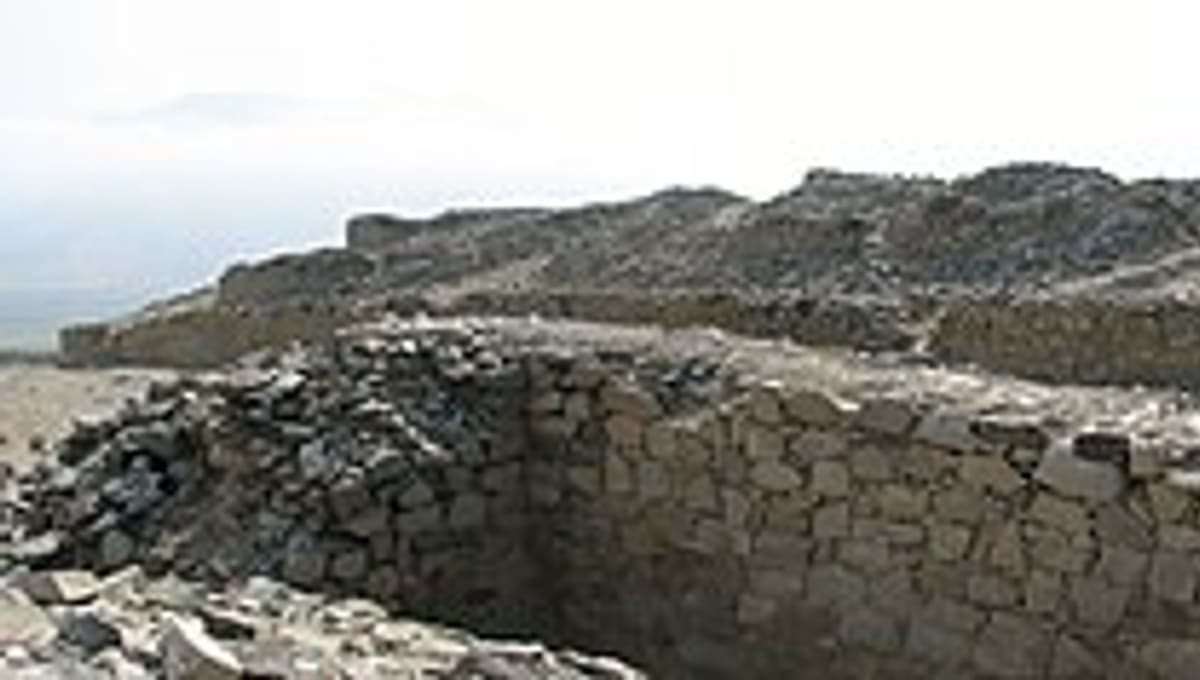
Image: Wikimedia Commons
On a dry hilltop in Peru's Casma-Sechin basin, Chankillo has watched over sunrises for more than two thousand years, long before it was recognised, in 2007, as one of the oldest astronomical observatories in the Americas.
About Chankillo
Chankillo is an ancient monumental complex in the Peruvian coastal desert, in the Ancash region, covering roughly four square kilometres. It combines the hilltop Chankillo fort, the Thirteen Towers solar observatory, and residential and gathering areas, all built by the Casma/Sechin culture, sometimes called the Sechin Complex.
History
The Thirteen Towers were built in the third century BC and run north to south along a ridge for about 300 metres, spaced roughly 5 metres apart, forming a distinctive toothed silhouette on the skyline. Watched from two fixed observation points, the rising and setting sun moves along the row of towers through the year, letting observers read off the date to within a day or two just from where the sun appeared to rise or set. Though travellers had known of the towers for two centuries, their purpose as a solar observatory was only formally identified in 2007, by archaeologists Ivan Ghezzi and Clive Ruggles. Chankillo was awarded UNESCO World Heritage status in July 2021.
Location & getting there
Chankillo sits in the Casma-Sechin basin of the Ancash Department, on Peru's northern coastal desert. (Use the map and directions above to plan your route.)
Visiting Chankillo
As a UNESCO World Heritage site, Chankillo is open to visitors, though facilities are modest compared with Peru's larger archaeological parks; check current access and opening arrangements with local tourism authorities before you go.
See your named star from here
The priests who built the Thirteen Towers tracked the sun's yearly path across the horizon using nothing but fixed stone markers, an early reminder that a point in the sky can be pinned down with precision from the ground. A star you've named through Star Register works the same way: it has fixed coordinates you can look up in our catalogue and find with a telescope or stargazing app wherever the night sky is dark enough. Name a star to start.
Opening hours and public-visit programs vary by season. Check Google Maps for current times before you travel.
Institutional and reference sources used to verify this guide.
Satellite imagery: Esri, Maxar, Earthstar Geographics

 1,039 km
 1,048 km