
Tonantzintla Observatory

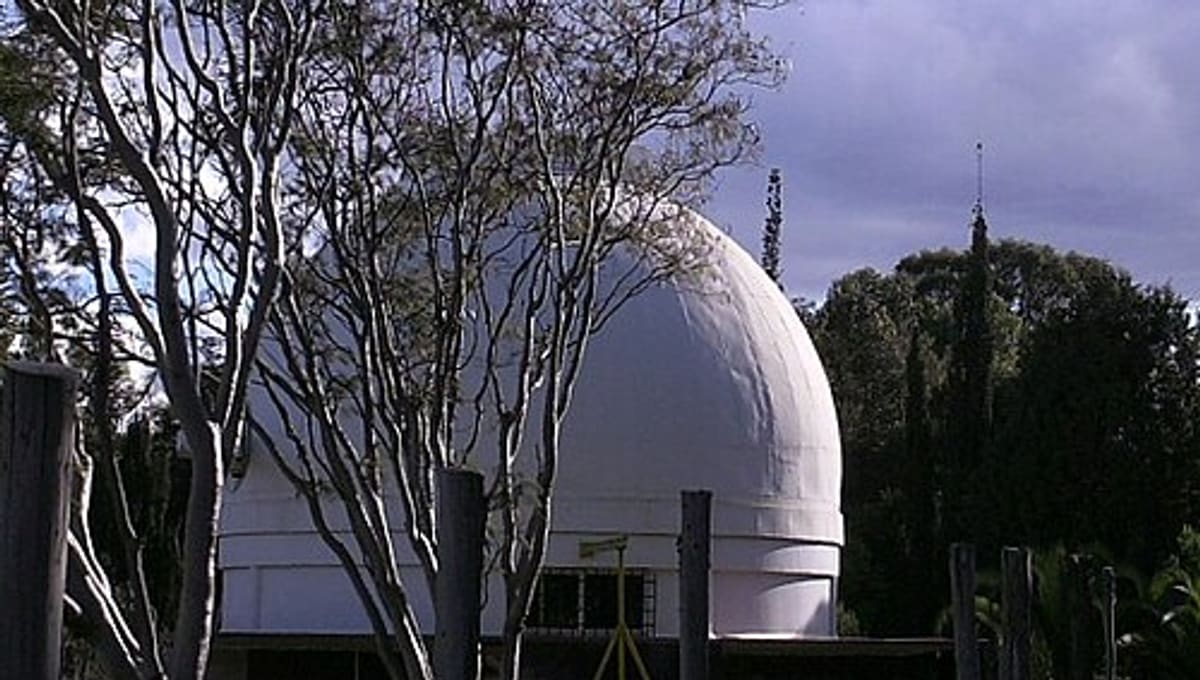
Image: Wikimedia Commons
Tonantzintla Observatory sits in the municipality of San Andrés Cholula in the Mexican state of Puebla, where two adjacent research facilities have shared the site since the 1940s.
About Tonantzintla Observatory
The observatory consists of two neighboring institutions: the National Astrophysical Observatory of Tonantzintla (OANTON), operated by the National Institute of Astrophysics, Optics and Electronics (INAOE), and the National Astronomical Observatory-Tonantzintla (OAN), operated by the National Autonomous University of Mexico (UNAM). OANTON sits on the INAOE campus, while OAN occupies mostly unused property immediately to the east.
History
Tonantzintla Observatory was founded in 1942 and formally dedicated that February in a ceremony attended by the President of Mexico, an initiative driven by astronomer Luis Enrique Erro.
Telescopes & research
The site's instruments include a 0.7-metre Schmidt camera and a 1.0-metre Cassegrain reflector. Research here has focused on Herbig–Haro objects and stellar cataloging, producing the well-known Tonantzintla Catalogue.
Location & getting there
Tonantzintla Observatory sits at 2,166 metres elevation, about 11 kilometres west of the city of Puebla and 33 kilometres east of the Popocatépetl volcano, whose occasional eruptions can interfere with observing (roughly 19.03°N, -98.32°W).
Visiting Tonantzintla Observatory
For current public tours, opening hours, or ticket information, check the observatory's official website or a recent Google search before planning your trip.
See your named star from here
With decades of experience aiming precision instruments at specific points in the sky, astronomers at Tonantzintla work with exactly the kind of coordinates that identify a named star's position. Explore our star-naming packages or browse the star catalogue to find yours.
Opening hours and public-visit programs vary by season. Check the official website and Google Maps for current times before you travel.
Institutional and reference sources used to verify this guide.
Satellite imagery: Esri, Maxar, Earthstar Geographics

 106 km
Texas Star Party, Inc.
One of three major annual star parties in the USA hosting dark site amateur astronomy events.