
Nagycenk Magnetic Observatory
Satellite imagery: Esri, Maxar, Earthstar Geographics
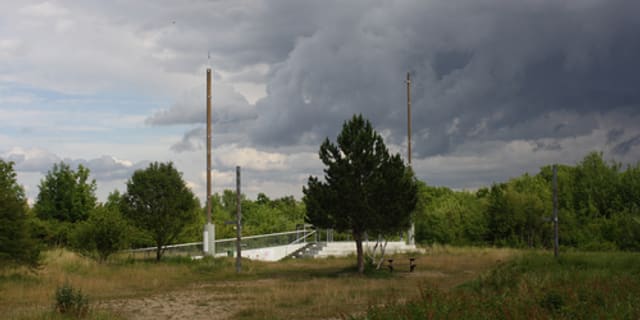
Nagycenk Magnetic Observatory is a geophysical research station near Sopron, Hungary, on the shore of Lake Fertő, dedicated to monitoring Earth's magnetic field rather than the night sky.
About Nagycenk Magnetic Observatory
Officially known as the Széchenyi István Geophysical Observatory, the station sits close to the village of Nagycenk, about 10 kilometres east of Sopron in western Hungary. It is operated by the geodetic and geophysical research institute of the Hungarian Academy of Sciences and carries the international IAGA station code NCK.
History
The observatory was founded in 1957, during the International Geophysical Year, and began continuous geomagnetic recordings in 1961, a series that has run uninterrupted ever since.
Research & instruments
Rather than telescopes, the station's instruments measure Earth's magnetic field, atmospheric electric potential gradient, Schumann resonances and ionospheric conditions, alongside routine meteorological monitoring. Its long, continuous geomagnetic record makes it a reference station for researchers studying the Earth's magnetic environment.
Location & getting there
The observatory is set on the shore of Lake Fertő, near Nagycenk, roughly 10 kilometres from the city of Sopron in western Hungary, close to the Austrian border.
Visiting Nagycenk Magnetic Observatory
As a working research station, the site is not primarily set up as a tourist attraction; anyone interested in visiting should check with the operating institute before travelling.
See your named star from here
Nagycenk Magnetic Observatory studies the Earth rather than the stars, so it isn't set up for stargazing. If you'd like to actually see the star you've named, star-register gives you its precise coordinates so that staff at any public observatory with a telescope can point it out for you. Take a look at our star-naming packages or browse the star catalogue.
Opening hours and public-visit programs vary by season. Check Google Maps for current times before you travel.
Institutional and reference sources used to verify this guide.
Satellite imagery: Esri, Maxar, Earthstar Geographics

 67 km
67 km
 72 kmResearch
 81 km
81 km
 112 km