
Purgathofer-Sternwarte

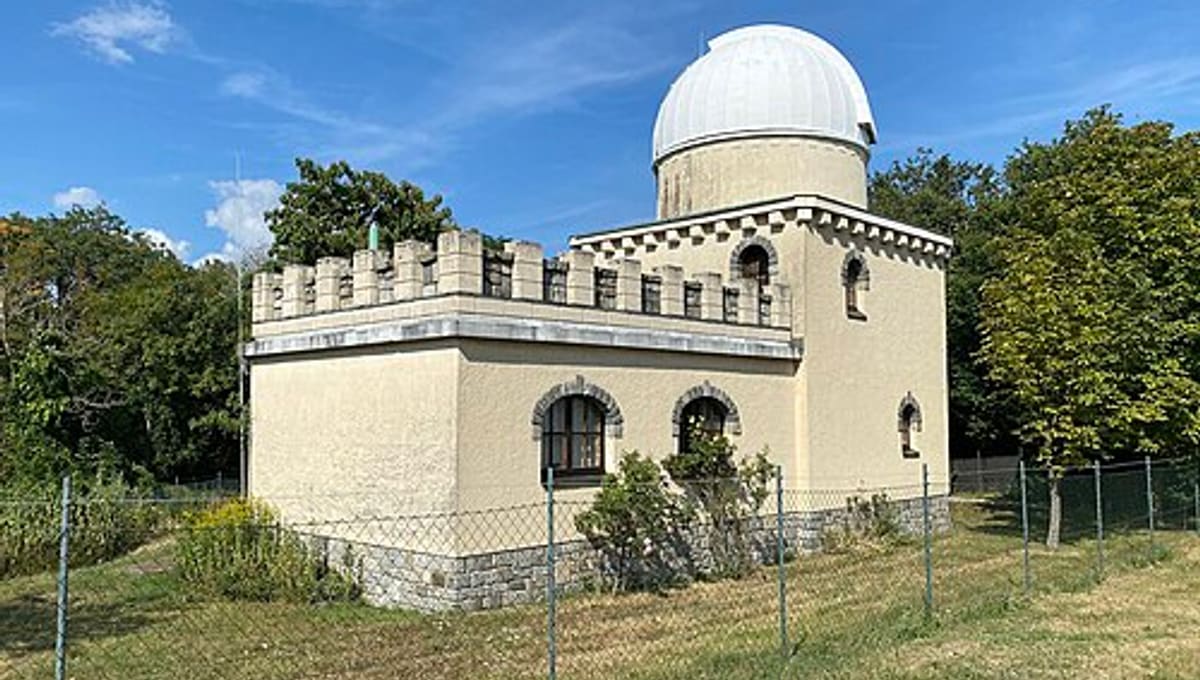
Image: Wikimedia Commons
In the hills above Klosterneuburg-Kierling in Lower Austria stands Purgathofer-Sternwarte, one of the largest privately built observatories in Europe. Its dome houses a metre-class telescope trained nightly on the deep sky.
About Purgathofer-Sternwarte
Purgathofer-Sternwarte is a private astronomical observatory named after Alois Purgathofer, an Austrian astronomer who worked at the Vienna Observatory before his death in 1984. The observatory carries his name in tribute to his contribution to Austrian astronomy.
History
The observatory was built between 1982 and 1989 by Rudolf Pressberger, whose dedication to the project produced what is regarded as the second-largest private observatory in Europe. Decades on, it remains a working research and teaching facility rather than a static monument.
Telescopes & research
At the heart of Purgathofer-Sternwarte is a reflecting telescope with a one-metre mirror and an 8.80-metre focal length, a scale rarely found outside professional institutes. Observers here have used it to study supernovae, variable stars and chemically peculiar stars, as well as to carry out astrometric measurements of comets and minor planets. The observatory also runs astronomy workshops and lectures for students, extending its research work into public education.
Location & getting there
The observatory sits in the hills near Klosterneuburg-Kierling, a short drive northwest of Vienna in Lower Austria. The elevated, semi-rural setting keeps it above some of the light pollution that affects the capital, giving its large mirror clearer skies to work with.
Visiting Purgathofer-Sternwarte
As a working observatory with an active research and teaching programme, Purgathofer-Sternwarte periodically welcomes visitors to its workshops and lectures. Because opening times are not fixed, check locally or with regional astronomy groups before planning a visit.
See your named star from here
Every star named through Star Register comes with precise coordinates, and an observatory with a metre-class telescope like this one is well equipped to find faint targets from those numbers alone. If you are planning a visit, bring the right ascension and declination from your certificate along. Browse naming packages or look up a star already registered in the catalogue.
Opening hours and public-visit programs vary by season. Check Google Maps for current times before you travel.
Institutional and reference sources used to verify this guide.
Satellite imagery: Esri, Maxar, Earthstar Geographics

 17 km
17 km
 52 kmResearch
 103 kmPlanetarium
 149 km