
Mould Bay Magnetic Observatory
Satellite imagery: Esri, Maxar, Earthstar Geographics
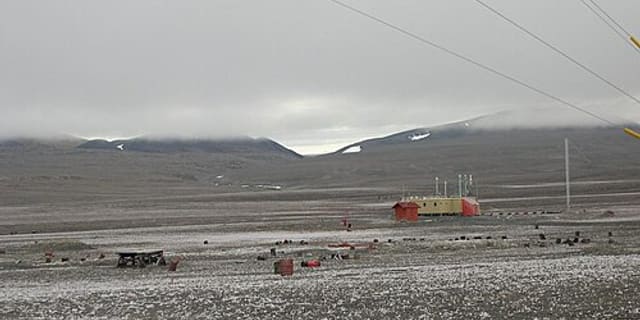
Mould Bay Magnetic Observatory was a remote geomagnetic and seismic research station on Prince Patrick Island, deep in Canada's Arctic archipelago in what is now Nunavut.
About Mould Bay Magnetic Observatory
The station combined a magnetic observatory with a seismic observatory, housed in an insulated, non-magnetic wooden building roughly 8 by 5 metres, connected by a 7-metre corridor to its seismic counterpart. It was operated by the Division of Geomagnetism at the Dominion Observatory, later part of the Geological Survey of Canada.
History
The observatory was established in the summer of 1961 at the Joint Arctic Weather Station in Mould Bay. It ran a digital standby magnetometer from late 1975 and upgraded to an AMOS Mk III magnetometer in July 1985. Staffed observations ended that same year, after which data reduction moved to Ottawa, and the station closed for good on March 31, 1997 due to budget cuts.
Location & getting there
Mould Bay sits at roughly 76.3°N on Prince Patrick Island in Nunavut, one of the most remote inhabited points ever established in the Canadian Arctic. There is no public road access or general tourist infrastructure at this former research site.
Visiting Mould Bay Magnetic Observatory
The station has been closed since 1997 and is not set up for public visits. Anyone with a specific interest in the site should check with the Geological Survey of Canada or Natural Resources Canada for current access and safety information before attempting any Arctic travel.
See your named star from here
Even from a site this remote, the night sky above Mould Bay is the same one your named star's coordinates point to. Name a star and find its exact position in the catalogue, wherever in the world you plan to look up.
Opening hours and public-visit programs vary by season. Check Google Maps for current times before you travel.
Institutional and reference sources used to verify this guide.
Satellite imagery: Esri, Maxar, Earthstar Geographics

 1,270 km
 2,838 km