
Newbrook Observatory
Satellite imagery: Esri, Maxar, Earthstar Geographics
Newbrook Observatory, a designated historic building in Newbrook, Alberta, played a small but memorable role in the early space age from a quiet corner of the Canadian prairies.
About Newbrook Observatory
Built in 1951, the observatory opened in 1952 as a field station of the Stellar Physics Division of the Dominion Observatory in Ottawa. It was equipped with a Super-Schmidt Meteor Camera, one of only six ever built by the Perkin-Elmer Company, and formed part of a 1946 US-Canada cooperative agreement on space science, with a particular focus on meteorite observations.
History
Newbrook Observatory operated from 1952 to 1957, during which it recorded more than 8,000 meteor spectrograph exposures. Its most famous moment came when resident scientist Art Griffin became the first person in North America to photograph the Soviet satellite Sputnik 1, less than a week after its launch. In 1970, the Canadian government consolidated its astronomical research, and Newbrook — along with the nearby Meanook facility about 23 miles to the northwest — was closed.
Location & getting there
The observatory is located in Newbrook, Alberta, a strategically chosen northerly site that offered clear night skies with minimal interference from the aurora, ideal for meteor tracking.
Visiting Newbrook Observatory
As a designated historic building, the site preserves an important piece of Canadian space science history. Check locally for current access details before visiting, since it is no longer an active research station.
See your named star from here
Alberta's northern skies, once used to track meteors and satellites, are just as good for spotting a single named star today. If you've named a star with Star Register, find its coordinates in our star catalogue and see if you can pick it out from the same dark prairie skies that once caught Sputnik 1.
Opening hours and public-visit programs vary by season. Check Google Maps for current times before you travel.
Institutional and reference sources used to verify this guide.
Satellite imagery: Esri, Maxar, Earthstar Geographics

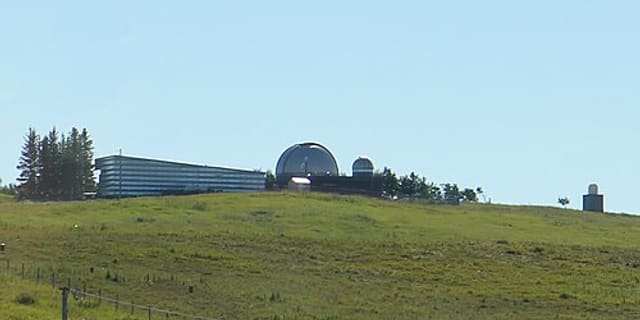 395 km
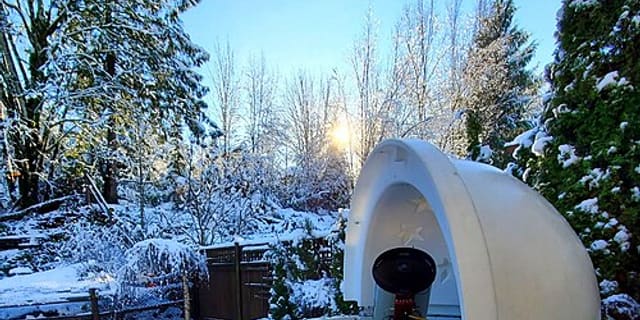 886 km
Golden Ears Observatory
astronomical observatory in Maple Ridge, British Columbia, Canada

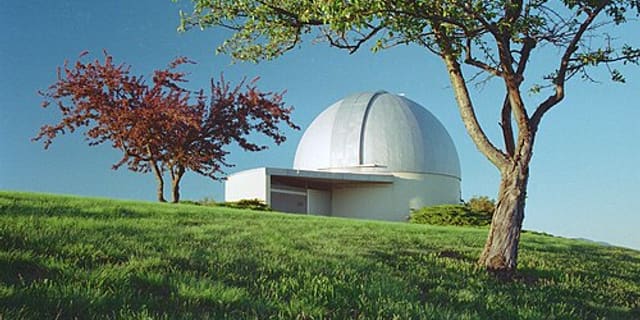 895 km