
Golden Ears Observatory


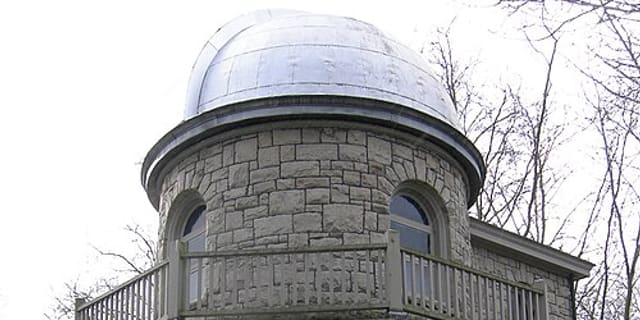
Image: Wikimedia Commons
Just east of Vancouver in Maple Ridge, British Columbia, the Golden Ears Observatory spends its nights scanning the sky for asteroids and stars caught in the act of changing.
About Golden Ears Observatory
Golden Ears Observatory is a privately operated facility sitting at an elevation of 41 metres, about 50 kilometres east of Vancouver. It runs two main instruments: a 14-inch wide-field Cassegrain telescope at f/1.9 that conducts autonomous nightly searches for near-Earth objects as part of a Minor Planet Survey, and a 10-inch Ritchey-Chretien telescope used to confirm new discoveries.
Telescopes & research
The observatory runs the Golden Ears Observatory Transient Survey (GEOTS) and is a signatory of the International Asteroid Warning Network (IAWN), contributing to planetary defence work through near-Earth object detection, tracking, and astrometry of potentially hazardous asteroids. Its first transient discovery, a dwarf nova in the constellation Cygnus, came on 5 May 2021; its 75th discovery, a transient in the constellation Andromeda, was announced on 23 July 2025.
Location & getting there
The observatory is located in Maple Ridge, British Columbia, Canada, roughly 50 kilometres east of Vancouver, at an elevation of 41 metres.
Visiting Golden Ears Observatory
As a privately operated research facility focused on autonomous nightly surveys, Golden Ears Observatory is not a general public visitor site. Check its official website for any current information on tours or outreach.
See your named star from here
An observatory built to track down faint, fast-changing objects across the sky is no stranger to working from precise coordinates. If you've named a star with Star Register, its certificate gives exactly that. Browse the star catalogue to find yours.
Opening hours and public-visit programs vary by season. Check the official website and Google Maps for current times before you travel.
Institutional and reference sources used to verify this guide.
Satellite imagery: Esri, Maxar, Earthstar Geographics

 152 km
 153 km
 271 km