
Battle Point Observatory


Image: Wikimedia Commons
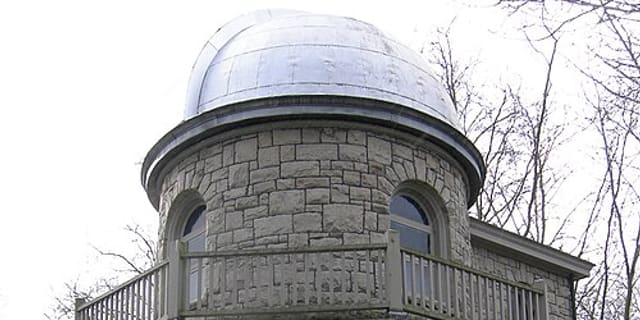
At Battle Point Park on Bainbridge Island, Washington, Battle Point Observatory grew out of a condemned World War II-era building into one of the Pacific Northwest's best-known community observatories.
About Battle Point Observatory
The observatory is run by the Battle Point Astronomical Association, a 501(c)(3) nonprofit, with a mission to create opportunities for people of all ages to experience the cosmos. Its site includes the Rudolph Planetarium, the Ritchie Workshop, and the Gardiner Library, alongside its observing facilities, and an equatorial bowstring sundial stands on the grounds.
History
The observatory was founded in 1992 by John H. Rudolph, Edwin Ritchie and Mac Gardiner, who built it from the shell of a WWII-era "Helix House" that had been scheduled for demolition. Basic construction was completed in 1997. For years the observatory housed a 27-inch Ritchie Telescope, once the largest public telescope in the Pacific Northwest, which was removed in 2024 to make way for newer equipment.
Telescopes & research
Beyond its main telescope, now being upgraded, the observatory runs the Rudolph Planetarium, with public shows on Saturdays at 12:30pm and 2:30pm (admission $10 for adults, $5 for children). The Ritchie Workshop and Gardiner Library round out a site built for hands-on public astronomy education rather than professional research.
Location & getting there
Battle Point Observatory sits within Battle Point Park on Bainbridge Island, Washington, a short ferry ride across Puget Sound from Seattle.
Visiting Battle Point Observatory
The observatory is open to the public on Fridays and Saturdays, 11am to 3pm, with planetarium shows on Saturdays at 12:30pm and 2:30pm ($10 adults, $5 children). Confirm current hours and any evening observing sessions on the Battle Point Astronomical Association's website before visiting.
See your named star from here
With regular public hours and a planetarium built for sharing the sky, Battle Point Observatory is an ideal place to plan around a star named through Star Register. Name a star as a gift, or browse the star catalogue to see what's already been named.
Opening hours and public-visit programs vary by season. Check Google Maps for current times before you travel.
Institutional and reference sources used to verify this guide.
Satellite imagery: Esri, Maxar, Earthstar Geographics

 20 km
20 km
 152 km
Golden Ears Observatory
astronomical observatory in Maple Ridge, British Columbia, Canada

 170 km