
Mårtsbo observatory


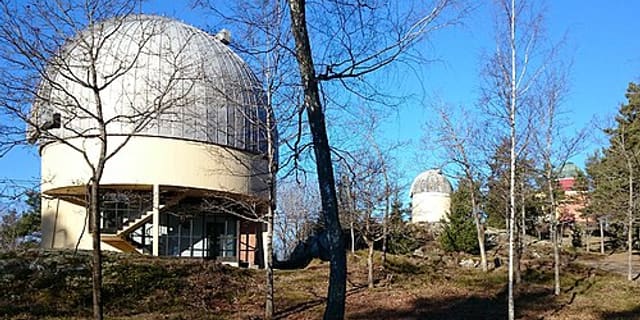
Image: Wikimedia Commons
Mårtsbo observatory, Mårtsboobservatoriet, sits about 12 kilometres south of Gävle, Sweden, where it has quietly tracked the shape and movement of the Earth's crust since 1974.
About Mårtsbo observatory
Mårtsbo observatory is a geodetic and GNSS research station operated by Lantmäteriet, the Swedish National Land Survey. Rather than studying distant stars, it uses satellite receiver stations to determine positions with centimetre-level accuracy, contributing data to both the European Permanent GNSS Network (EPN) and the International GNSS Service (IGS).
History
The station was established in 1974, when Lantmäteriet relocated from Stockholm to Gävle. Mårtsbo became the agency's dedicated site for precise geodetic measurement, and it has continued that role for half a century since.
Telescopes & research
Mårtsbo's work centres on gravity measurements and satellite positioning as part of the SWEPOS network, monitoring subtle shifts in the shape of the Earth's crust over time. The site is mostly unmanned today, with its equipment remotely controlled from Lantmäteriet's offices in Gävle.
Location & getting there
The observatory lies in Europe, in Sweden's Gästrikland region, a short distance south of the city of Gävle on the country's eastern coast.
Visiting Mårtsbo observatory
As a largely unmanned technical facility rather than a public attraction, Mårtsbo observatory does not appear to offer scheduled public visits. Anyone interested in seeing the site should contact Lantmäteriet directly before travelling.
See your named star from here
Mårtsbo is dedicated to geodesy rather than public stargazing, but the underlying idea is the same one that makes a named star findable: precise coordinates. Just as Mårtsbo's receivers fix a location on Earth to within centimetres, a star named through Star Register comes with its own exact right ascension and declination, so it can be located from an observatory anywhere. Browse the catalogue to find a star, or choose a naming package to name one yourself.
Opening hours and public-visit programs vary by season. Check Google Maps for current times before you travel.
Institutional and reference sources used to verify this guide.
Satellite imagery: Esri, Maxar, Earthstar Geographics

 123 kmMuseum
 146 kmMuseum