
Lijiang Station
Satellite imagery: Esri, Maxar, Earthstar Geographics
High on Tiejia Mountain in Yulong County near Lijiang, in China's Yunnan province, Lijiang Station is one of the most productive optical observatories in Asia. Sitting at roughly 3,200 metres above sea level, the site takes advantage of clean, transparent mountain air far from city lights. It is operated by the Yunnan Astronomical Observatory.
About Lijiang Station
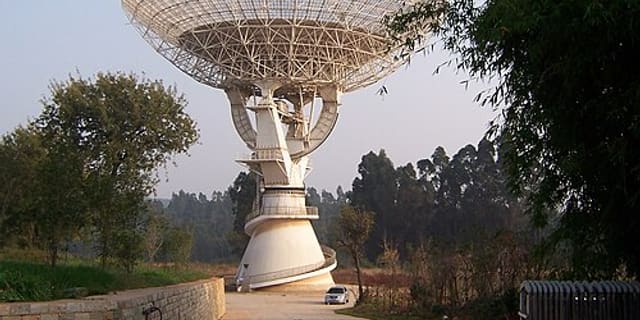
Lijiang Station's flagship instrument is the Lijiang 2.4-metre Telescope (LJT), the largest common-purpose optical telescope in China, which has been in operation since 2008. The site also hosts a 1.8-metre telescope used to test adaptive optics systems, a 60-centimetre BOOTES-4 fully automatic telescope, and the TAT telescope operated by Tsinghua University.
Telescopes & research
The LJT has become one of the most heavily used telescopes of its class anywhere in the world. Roughly 30% of all active galactic nuclei studied worldwide have been identified using data from Lijiang, and about one in ten supernovae observed globally have been recorded here. Astronomers working at the station have measured the masses of more than 41 high-accretion-rate black holes and catalogued over 168 supernovae, contributing significantly to research on galaxy evolution and stellar explosions.
Location & getting there
The observatory's mountaintop position in Yunnan gives it minimal air pollution and unusually clear, stable skies, part of why it was chosen as a research site. Its remote elevation makes it primarily a working scientific facility rather than a casual tourist stop, so anyone planning a visit should confirm access arrangements with the operating institute in advance.
See your named star from here
Because every star name from Star Register comes with precise coordinates, an observatory like this one can, in principle, point a telescope at the exact right ascension and declination of your named star. If you'd like to give someone a star of their own, browse the naming packages or explore the night sky already catalogued in our star catalogue.
Opening hours and public-visit programs vary by season. Check Google Maps for current times before you travel.
Institutional and reference sources used to verify this guide.
Satellite imagery: Esri, Maxar, Earthstar Geographics

 332 km
 1,361 kmResearch
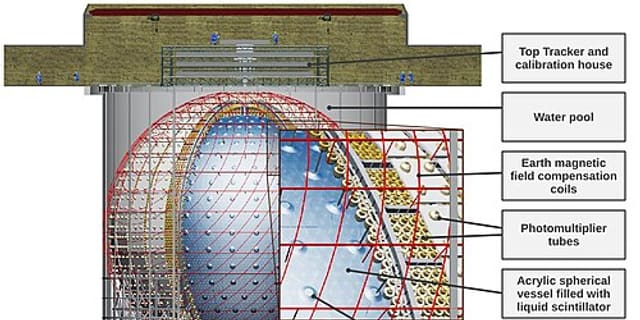
Jiangmen Underground Neutrino Observatory
neutrino experiment in Jiangmen, China

 1,913 km