
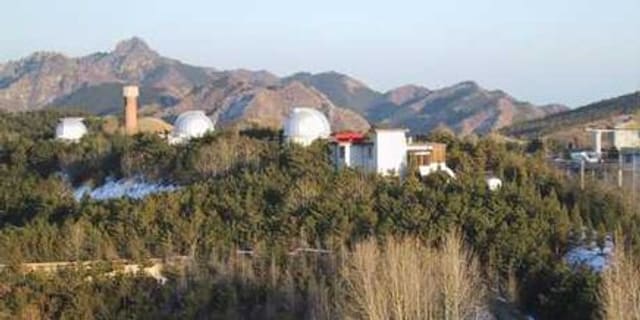
Purple Mountain Observatory


Image: Wikimedia Commons
East of Nanjing, China, Purple Mountain Observatory has watched the sky since 1928, growing from a single hilltop institute into one of the country's leading centres for astronomy and space-object tracking.
About Purple Mountain Observatory
Purple Mountain Observatory, also known as Zijinshan Astronomical Observatory, is headquartered on Purple Mountain east of Nanjing at an elevation of 267 metres. It is operated jointly by the Chinese Academy of Sciences and the People's Liberation Army Aerospace Force, and it maintains sensor installations at sites across China in addition to its Nanjing headquarters.
History
The observatory was founded in 1928 as the Institute of Astronomy under Academia Sinica and took the name Purple Mountain Observatory in 1950. Since the early 2000s it has also taken on a classified role in optical space domain awareness for China.
Telescopes & research
Purple Mountain Observatory is China's primary contributor to the Inter-Agency Space Debris Coordination Committee and plays a central role in global asteroid impact avoidance efforts. It also calculates the official Chinese calendar each year, a duty with roots in the institute's earliest work. Part of its military-linked observing programme is run by PLA Aerospace Force Base 26 through the Space Target and Debris Observation and Research Center.
Location & getting there
The main site sits on Purple Mountain itself, just east of central Nanjing in eastern China, at 267 metres above sea level. Its hillside position was originally chosen to lift its telescopes above the haze of the city below.
Visiting Purple Mountain Observatory
Details of public opening hours and tours are best confirmed on the observatory's official website before travelling, since access to a working national research site can vary.
See your named star from here
A star named through Star Register comes with exact right ascension and declination, the same kind of coordinates that professional observatories like this one use every night. Staff experienced with locating precise targets can point a telescope at your star's position if you bring your certificate details. Start with our naming packages or search the catalogue for a star already on record.
Opening hours and public-visit programs vary by season. Check the official website and Google Maps for current times before you travel.
Institutional and reference sources used to verify this guide.
Satellite imagery: Esri, Maxar, Earthstar Geographics

 249 km
 898 km
 933 km