
Xinglong Station

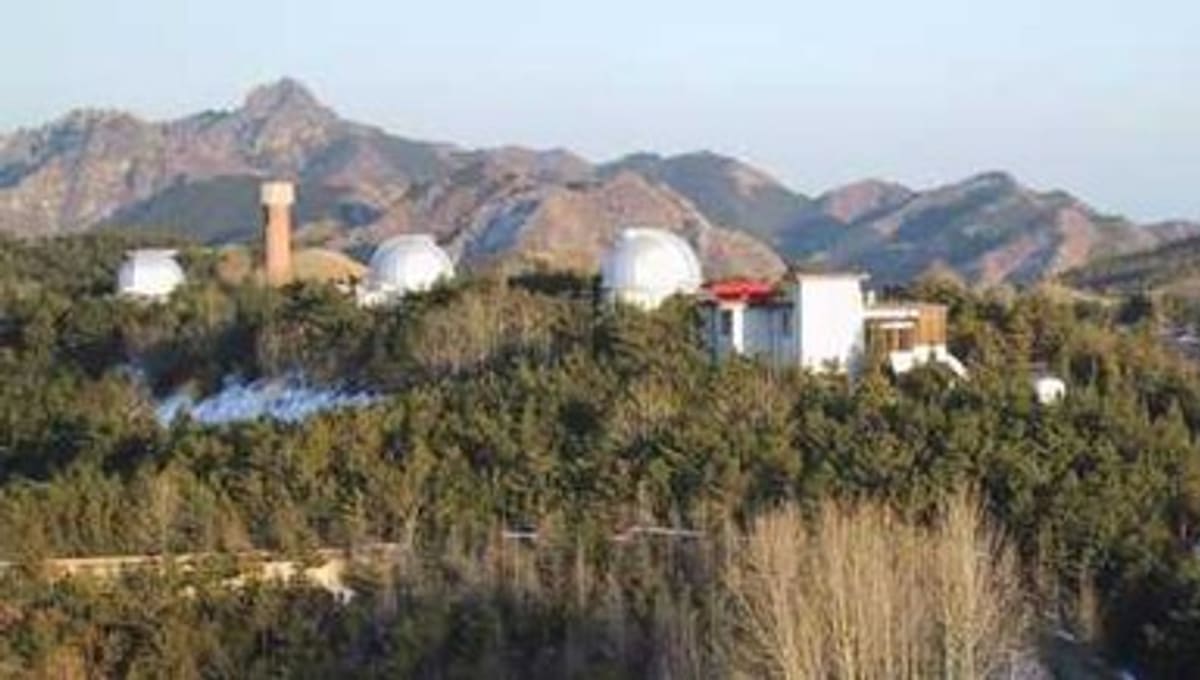
Image: Wikimedia Commons
Xinglong Station rises in the Yanshan Mountains of Hebei Province, China, about 150 km northeast of Beijing, and ranks as the largest observatory in Asia.
About Xinglong Station
Administered by the National Astronomical Observatories of the Chinese Academy of Sciences (NAOC), Xinglong Station carries IAU observatory code 327 and sits at an elevation of around 900 metres. It houses nine telescopes with apertures larger than 50 cm, making it the biggest concentration of large telescopes anywhere in Asia.
History
The observatory was founded in 1968. Its 2.16-metre Ritchey-Chrétien reflector, completed in 1989, was China's first telescope in the 2-metre class and remained the country's largest for around 18 years.
Telescopes & research
Alongside the 2.16-metre reflector, Xinglong's instruments include LAMOST, a 4-metre telescope designed for large-scale spectroscopic surveys; a 1.26-metre infrared reflector; a 1-metre alt-azimuth reflector; 85-cm and 80-cm reflectors; a 60/90-cm Schmidt telescope; and 60-cm and 50-cm reflectors. A 5.2-metre telescope was added in 2014 as part of the site's gamma-ray astronomy program.
Location & getting there
Xinglong Station sits south of the main Yanshan peaks in Xinglong County, Chengde, Hebei Province, within reach of Beijing. Use the map and directions button on this page to plan your route.
Visiting Xinglong Station
Xinglong Station is a popular tourist site, though as with any active research observatory, it's worth checking current visiting arrangements with NAOC or the observatory's official website before travelling.
See your named star from here
With nine telescopes trained on the sky, Xinglong Station is exactly the kind of place that could locate a star named through our star-naming packages using its precise coordinates. Browse the catalogue to see stars already named.
Opening hours and public-visit programs vary by season. Check the official website and Google Maps for current times before you travel.
Institutional and reference sources used to verify this guide.
Satellite imagery: Esri, Maxar, Earthstar Geographics
Beijing Astronomical Observatory
post-Communist revolution observatory

 112 km
 837 km