
Shahe Station (Beijing Observatory)
Satellite imagery: Esri, Maxar, Earthstar Geographics
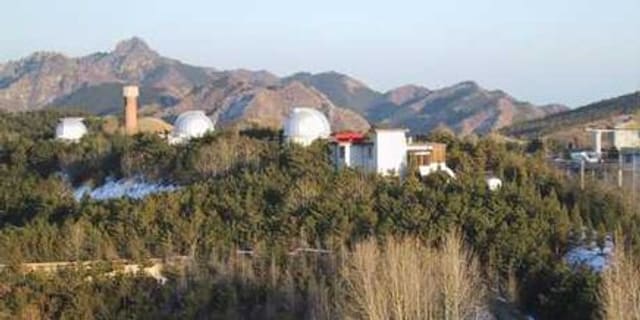
In the northern suburbs of Beijing, Shahe Station has served as a working timekeeping site for the Chinese Academy of Sciences since 1956, later becoming one of five observing stations under the Beijing Astronomical Observatory.
About Shahe Station (Beijing Observatory)
Shahe was selected as a workstation site in Beijing's northern suburbs and became one of five observing stations that together make up the Beijing Astronomical Observatory, founded by the Chinese Academy of Sciences in 1958.
History
The station was established in 1956 as a time service facility, and construction of the wider National Astronomical Observatories, including Shahe, began in 1957. By August 1958, an underground clock room was in operation using West German quartz clocks. From May 1, 1960 until 1995, Shahe transmitted a standard time signal via cable to the Central People's Broadcasting Station, accurate to 0.01 seconds.
Telescopes & research
Shahe's role centered on precision timekeeping and signal distribution rather than deep-sky observation, a specialty that made it central to China's national time standard for decades.
Location & getting there
The station sits in the northern suburbs of Beijing, China, part of the wider Asia region, as one of the five observing stations of the Beijing Astronomical Observatory.
Visiting Shahe Station (Beijing Observatory)
Public visiting arrangements for this working station aren't confirmed, so check with the Beijing Astronomical Observatory or search online for current access before planning a trip.
See your named star from here
Precision timekeeping and precise sky coordinates go hand in hand, the same principle behind any star named through Star Register, each with its own right ascension and declination. Find yours in the catalogue.
Opening hours and public-visit programs vary by season. Check Google Maps for current times before you travel.
Institutional and reference sources used to verify this guide.
Satellite imagery: Esri, Maxar, Earthstar Geographics

 23 km
23 km
 111 km
Beijing Astronomical Observatory
post-Communist revolution observatory

 921 km