
Jiangmen Underground Neutrino Observatory

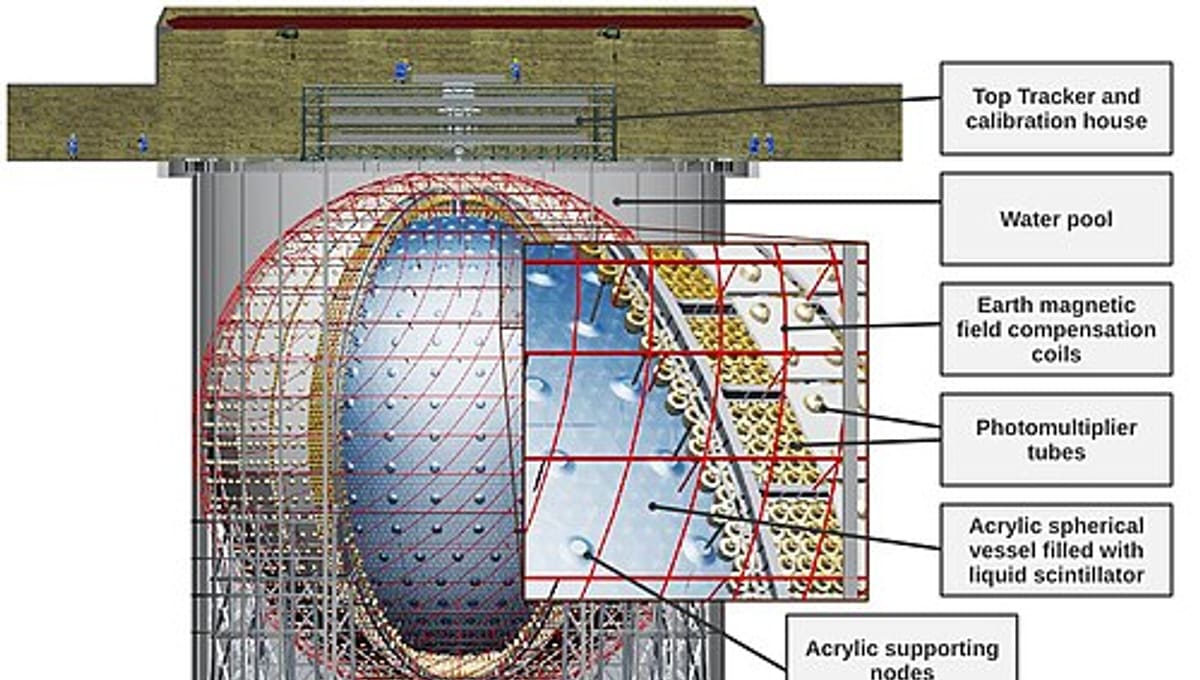
Image: Wikimedia Commons
The Jiangmen Underground Neutrino Observatory, or JUNO, sits 700 metres beneath Kaiping in Jiangmen, Guangdong province, China, home to the world's largest transparent spherical particle detector.
About Jiangmen Underground Neutrino Observatory
JUNO is a medium-baseline reactor neutrino experiment rather than a conventional sky-facing observatory. Its detector is a 35.4-metre transparent acrylic sphere filled with 20,000 tonnes of liquid scintillator and surrounded by roughly 43,200 photomultiplier tubes, buried 700 metres underground to shield it from cosmic-ray interference.
History
The JUNO collaboration was established in July 2014, with construction beginning on 10 January 2015. The experiment began operations on 26 August 2025. It now involves around 750 scientists from 17 countries, the largest international collaboration working on any experiment in China, at a total cost of about US$376 million.
Telescopes & research
Rather than telescopes, JUNO relies on its giant underground detector to catch neutrinos from the nearby Yangjiang and Taishan nuclear power plants, roughly 53 kilometres away. Its goals are to determine the neutrino mass hierarchy and make precision measurements of the Pontecorvo-Maki-Nakagawa-Sakata matrix, work that probes the fundamental behaviour of these famously elusive particles.
Location & getting there
JUNO is located at Kaiping, in Jiangmen, Guangdong province, China, in the Asia region, positioned deliberately between two nuclear power stations that supply its neutrino source.
Visiting Jiangmen Underground Neutrino Observatory
As an active underground physics experiment, JUNO is not a public visitor attraction. Those interested in its research should follow updates from the collaboration or the Institute of High Energy Physics rather than expecting site access.
See your named star from here
JUNO's detector looks for particles arriving from below rather than stars overhead, but the same idea of precise coordinates applies to any star named through Star Register: give the right position to a real telescope anywhere on the surface, and it can find it. Name a star, or browse the catalogue of stars already named.
Opening hours and public-visit programs vary by season. Check the official website and Google Maps for current times before you travel.
Institutional and reference sources used to verify this guide.
Satellite imagery: Esri, Maxar, Earthstar Geographics

 870 km
 1,042 km
 1,174 km
Haterumajima Astronomical Observatory Tower
observatory on Hateruma Island, Okinawa, Japan