
Large High Altitude Air Shower Observatory
Satellite imagery: Esri, Maxar, Earthstar Geographics
High on the Sichuan plateau in Daocheng, in China's Garzê Tibetan Autonomous Prefecture, the Large High Altitude Air Shower Observatory (LHAASO) watches the sky for the faint traces left by gamma rays and cosmic rays slamming into the atmosphere.
About LHAASO
LHAASO is a gamma-ray and cosmic-ray observatory designed to detect air showers, the cascades of particles produced when high-energy gamma rays and cosmic rays strike Earth's atmosphere. It is operated by the Institute of High Energy Physics (IHEP), with research teams from Australia and Thailand participating directly and other international groups involved.
History
Observations at LHAASO began in April 2019. The site covers roughly 145 hectares and includes three underground observing pools, each described as more than triple the size of Beijing's Water Cube; one pool alone is designed to hold 100,000 tonnes of water.
Telescopes & research
The pools house twelve telescopes built to capture high-energy photons, working alongside Cherenkov radiation detectors that register the faint blue light produced as shower particles pass through water and air. The design builds on the earlier CASA-MIA observatory, but with a larger surface array, improved muon detectors, a refined layout, and LHAASO's much higher altitude.
Location & getting there
LHAASO sits at 4,410 metres above sea level in Daocheng County, Sichuan, one of the highest-altitude observatory sites anywhere, chosen precisely because thinner, drier air improves the detection of atmospheric air showers.
Visiting LHAASO
LHAASO is a working scientific research facility rather than a public observatory, so anyone hoping to visit should check with IHEP or a local tour operator for current access before travelling.
See your named star from here
LHAASO's detectors are tuned to gamma rays and cosmic rays rather than starlight, but Daocheng's thin, high-altitude air also makes for outstanding naked-eye stargazing nearby. Name a star with Star Register and you'll receive its coordinates to find with an app or telescope under those dark plateau skies. See our star-naming packages or search the star catalogue.
Opening hours and public-visit programs vary by season. Check Google Maps for current times before you travel.
Institutional and reference sources used to verify this guide.
Satellite imagery: Esri, Maxar, Earthstar Geographics

 547 km
 1,476 kmResearch
Jiangmen Underground Neutrino Observatory
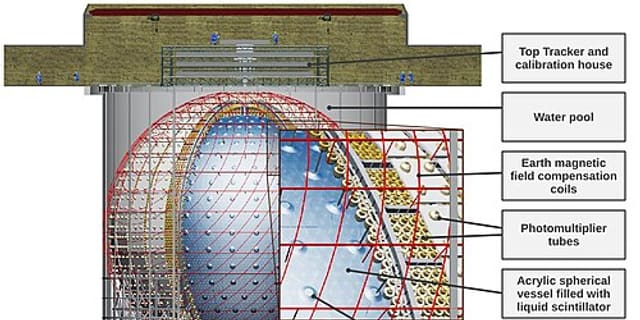
neutrino experiment in Jiangmen, China