
Himalayan Chandra Telescope, IAO
Satellite imagery: Esri, Maxar, Earthstar Geographics
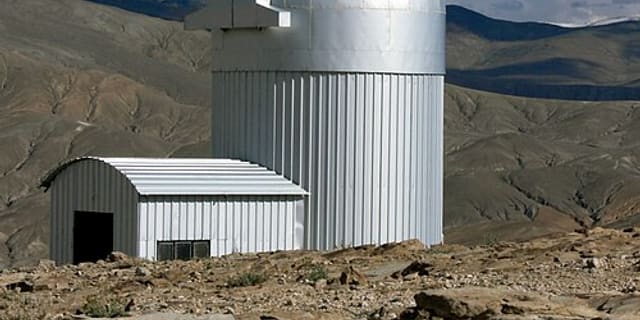
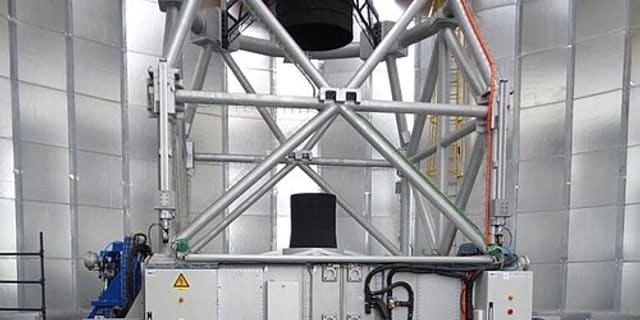
The Himalayan Chandra Telescope sits at the Indian Astronomical Observatory in Hanle, Ladakh, India, one of the highest optical observing sites on Earth.
About the Himalayan Chandra Telescope, IAO
Operated by the Indian Institute of Astrophysics, the Indian Astronomical Observatory at Hanle hosts the 2.01-metre Himalayan Chandra Telescope alongside the 0.7-metre robotic GROWTH-India Telescope, a pair of IIA–Washington University Cassegrain telescopes, and the High Altitude Gamma Ray (HAGAR) telescope array. Sited at roughly 4,500 metres above sea level, it benefits from thin, dry, dark high-altitude air that delivers around 255 spectroscopic nights and 190 photometric nights a year.
History
First light for the Himalayan Chandra Telescope came in September 2000, and the observatory was formally dedicated to the nation on 29 August 2001. In September 2022, the surrounding area was declared India's first dark-sky preserve, protecting the exceptional observing conditions that led the Indian Institute of Astrophysics to build here in the first place.
Telescopes & research
Beyond the flagship 2.01-metre optical-infrared telescope, the site's GROWTH-India Telescope supports time-domain and transient astronomy, while the HAGAR array observes high-energy gamma rays. Together they make Hanle one of the most versatile high-altitude observing sites in Asia, used for research spanning optical, infrared, and gamma-ray astronomy.
Location & getting there
Hanle lies in the Changthang region of Ladakh, in far northern India, at an elevation that puts it above much of the Earth's atmosphere and away from lowland light pollution and humidity. The remoteness and altitude that make it scientifically valuable also mean a visit requires careful planning around altitude and travel logistics.
Visiting the Himalayan Chandra Telescope, IAO
As a working research observatory in a remote, high-altitude dark-sky preserve, public access is limited compared with a visitor-oriented planetarium; check the Indian Institute of Astrophysics's official channels for current visiting arrangements before travelling.
See your named star from here
Few sites on Earth offer skies as dark and steady as Hanle's. If you've named a star with Star Register, its coordinates are the kind of target astronomers at a high-altitude site like this observe every clear night; find your star's position in our catalogue.
Opening hours and public-visit programs vary by season. Check Google Maps for current times before you travel.
Institutional and reference sources used to verify this guide.
Satellite imagery: Esri, Maxar, Earthstar Geographics

 under 1 km
Indian Astronomical Observatory (IAO)
located near Leh, Ladakh, India; has one of the world's highest sites for optical, infrared, gamma-ray telescopes

 386 km
Devasthal Observatory
observatory center under department of science and technology government of India situated at Uttrakhand India