
Erciyes University Radio Observatory
Satellite imagery: Esri, Maxar, Earthstar Geographics
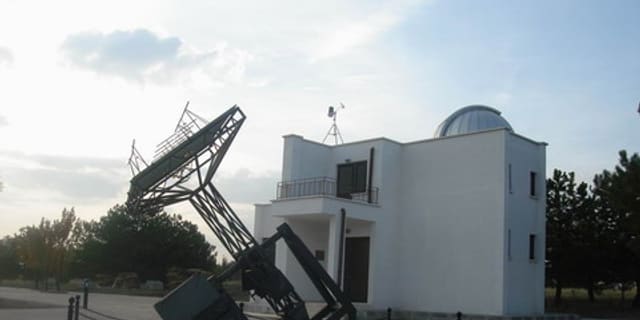
On the Erciyes University campus in Kayseri, central Turkey, a cluster of radio dishes and small optical telescopes forms one of the country's dedicated radio astronomy facilities.
About Erciyes University Radio Observatory
Formally the Erciyes University Astronomy and Space Science Observatory Applied Research Center (UZAYBİMER), the facility is operated by the Astronomy and Space Sciences Department within the university's Faculty of Science, at Melikgazi in Kayseri. It was founded in 2006 and sits at around 1,050 meters elevation on the university campus.
History
The observatory's first radio telescope, a 2-meter parabolic antenna known as MRT-2, was originally acquired from the Institute of Radio Astronomy in Kharkiv, Ukraine, in 1996 with support from UNIDO, and later donated to the university by the Marmara Research Center of TÜBİTAK. Built to detect carbon monoxide across the Milky Way at 85–115 GHz, it broke down in 1997 and, after repeated repair attempts, was rehabilitated by Erciyes University between 2001 and 2002. Two further 5-meter antennas (ERT-5) arrived from Türk Telekom in 2000 for an interferometer project.
Telescopes & research
Today the observatory operates a 12.8-meter single-dish Cassegrain radio telescope housed inside a 22-meter radome, both donated by NATO SATCOM, alongside a 3-meter antenna and two optical reflecting telescopes of 30 cm and 40 cm diameter. The radio instruments work across the 4.5, 11 and 20 GHz frequency bands.
Location & getting there
The observatory is located on the Erciyes University campus at Melikgazi, in Kayseri, central Turkey, at an elevation of roughly 1,050 meters — high ground that benefits both its radio and optical work.
Visiting Erciyes University Radio Observatory
As a university research center, access is generally organized around academic activity rather than casual tourism. Check the observatory's official website for any public outreach events or visiting arrangements before planning a trip.
See your named star from here
Between its radio dishes and its 30 cm and 40 cm optical telescopes, this observatory has more than one way of looking at the sky. If you've named a star through Star Register, its coordinates are recorded in our catalogue and can be shared with staff at an observatory like this one for a closer look.
Opening hours and public-visit programs vary by season. Check the official website and Google Maps for current times before you travel.
Institutional and reference sources used to verify this guide.
Satellite imagery: Esri, Maxar, Earthstar Geographics

 270 kmResearch
 612 kmResearch
 617 kmResearch