
Eastern Anatolia Observatory
Satellite imagery: Esri, Maxar, Earthstar Geographics
Eastern Anatolia Observatory, known as DAG, is a 4-meter telescope facility run by Atatürk University near Erzurum, Turkey, built on Karakaya Hill at 3,170 metres above sea level.
About Eastern Anatolia Observatory
DAG is Turkey's largest astronomy project and home to the country's first infrared telescope. Its active primary mirror is 4 metres in diameter and equipped with adaptive optics technology to sharpen images despite atmospheric turbulence. The telescope was built by the Belgian company AMOS, with the rotating hemispherical dome constructed by Italy's EIE Group Srl.
History
The project was launched by Atatürk University's Astrophysics Research and Application Center, with scientific and technical coordination from TÜBİTAK National Observatory and financial backing from Turkey's Ministry of Development, the Erzurum provincial government, 40 universities and seven observatories across the region. The telescope contract was awarded to AMOS in 2014 and the dome contract to EIE Group in 2015. DAG reached technical first light in 2024 and completed initial testing in September 2025.
Telescopes & research
At its core is a 4-metre infrared telescope with adaptive optics, the largest of its kind in Turkey, designed to support research across astrophysics, astronomy and space science from one of the highest observatory sites in the region.
Location & getting there
Eastern Anatolia Observatory sits within the Konaklı Ski Resort, about 25 km south of Erzurum, Turkey, in the Asia region, at 3,170 metres elevation, on land spanning 2,500 decares atop Karakaya Hill.
Visiting Eastern Anatolia Observatory
As a research telescope only recently completed, public visiting arrangements are best confirmed through the observatory's official website before planning a trip.
See your named star from here
A 4-metre telescope with adaptive optics, sitting above 3,000 metres, is exactly the kind of instrument that can resolve a single star from its precise coordinates. If you've named a star with Star Register, this is the scale of equipment that could find it. Explore our star-naming packages or browse the catalogue.
Opening hours and public-visit programs vary by season. Check the official website and Google Maps for current times before you travel.
Institutional and reference sources used to verify this guide.
Satellite imagery: Esri, Maxar, Earthstar Geographics

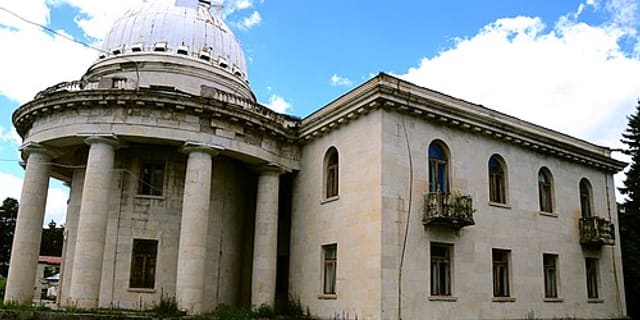 257 km
Georgian National Astrophysical Observatory
observatory in Abastumani, Adigeni Municipality, Georgia

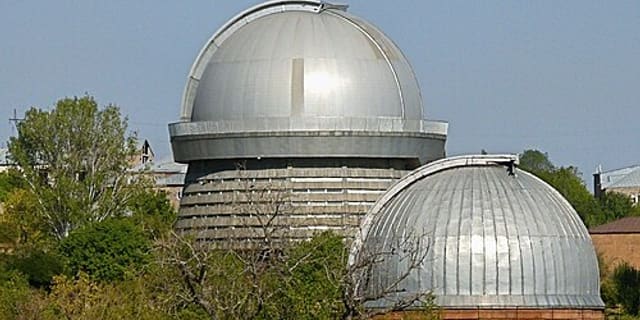 266 km
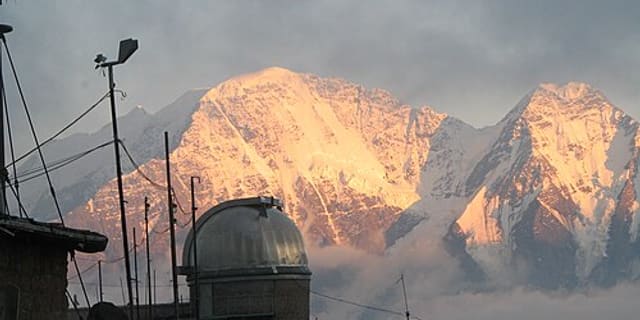 403 km
 403 km