
Byurakan Observatory


Image: Wikimedia Commons
High on the slopes of Mount Aragats in Armenia, Byurakan Observatory has studied the sky since 1946 and today doubles as one of the world's pioneering destinations for astronomy tourism.
About Byurakan Observatory
Byurakan Astrophysical Observatory sits at around 1,500 metres on the slope of Mount Aragats, near the village of Byurakan in Armenia. It is owned and operated by the Armenian Academy of Sciences and remains one of the country's leading centres for astrophysical research.
History
The observatory was founded in 1946 by the astrophysicist Viktor Hambardzumyan and quickly became one of the principal astronomy centres of the Soviet Union. Hambardzumyan's former residence on site is preserved today as a house-museum that visitors can tour.
Telescopes & research
Byurakan's best-known instrument is its 1-metre Schmidt telescope, one of the largest of its type in the world. Astronomer B. M. Markarian used it for a landmark objective-prism survey that catalogued around 1,500 galaxies with unusually strong ultraviolet emission, a dataset that remains an important source of Seyfert galaxies and starburst systems.
Location & getting there
The observatory is located in Aragatsotn Province in Armenia, on the lower slopes of Mount Aragats, the country's highest peak. Its elevation of roughly 1,500 metres keeps the site cooler and darker than the surrounding lowlands.
Visiting Byurakan Observatory
Byurakan runs guided tours for individual travellers, school groups, and researchers, covering Hambardzumyan's work, the observatory's telescopes and towers, its library and laboratories, and the house-museum. On clear spring, summer, and autumn evenings, visitors can often observe stars, planets, nebulae, and galaxies in real time through the observatory's telescopes. In 2016 the International Astronomical Union recognised Byurakan as the initiator of astronomical tourism worldwide, so booking ahead through the observatory's own tour programme is recommended.
See your named star from here
Byurakan's astronomers already spend their evenings guiding visitors' eyes to specific points in the sky, so pointing a telescope toward your own named star's coordinates fits naturally into a visit. Look up its position in the star catalogue, or name a star before you go.
Opening hours and public-visit programs vary by season. Check the official website and Google Maps for current times before you travel.
Institutional and reference sources used to verify this guide.
Satellite imagery: Esri, Maxar, Earthstar Geographics

 194 km
 200 km
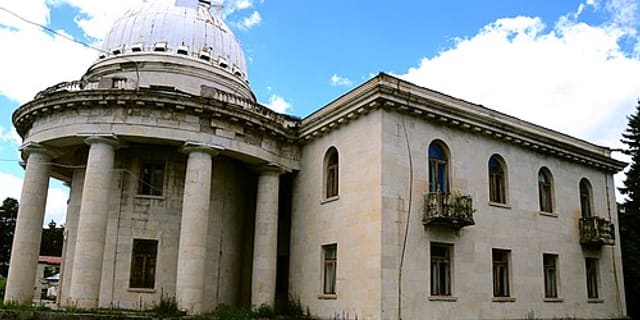
Georgian National Astrophysical Observatory
observatory in Abastumani, Adigeni Municipality, Georgia

 354 km
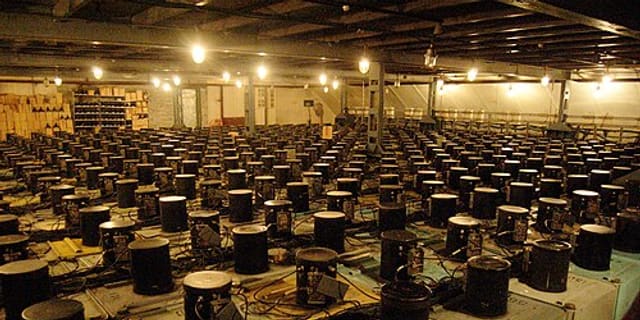
Baksan Neutrino Observatory
scientific laboratory mainly studying neutrinos; located in the Caucasus mountains in Russia

 359 km