
Baksan Neutrino Observatory

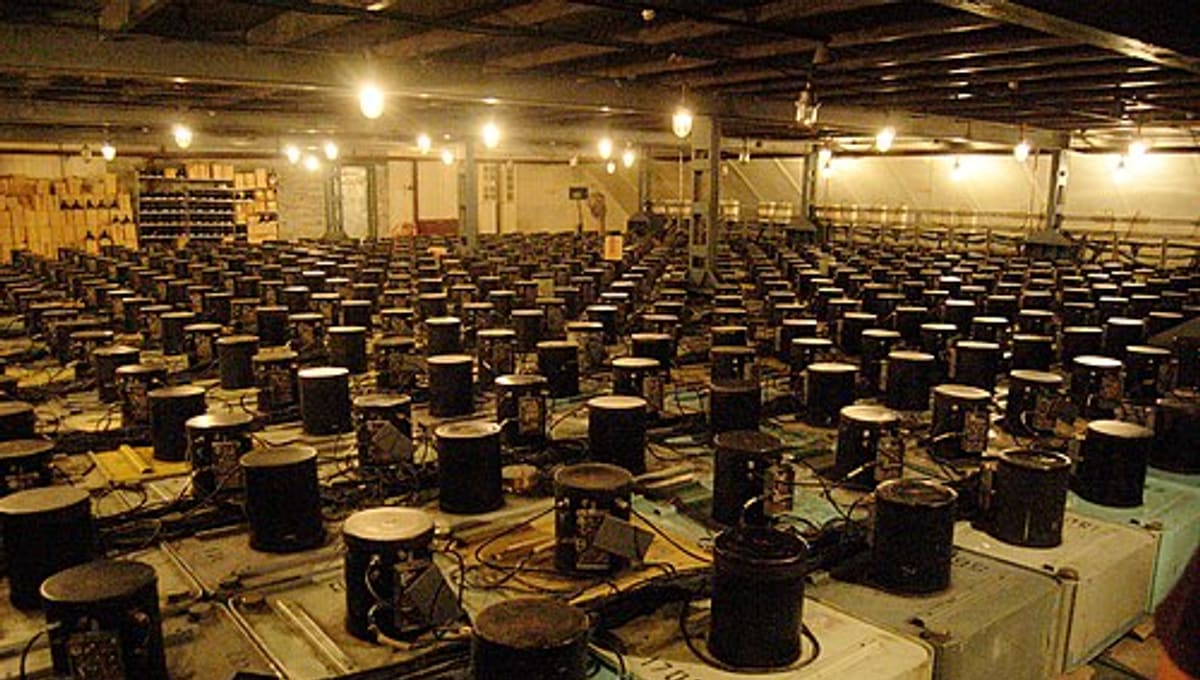
Image: Wikimedia Commons
Deep inside Mount Andyrchi in Russia's Caucasus mountains, the Baksan Neutrino Observatory has probed the universe's most elusive particles since the 1970s. Run by the Institute for Nuclear Research of the Russian Academy of Sciences, it is one of only two major underground physics laboratories operating in the world today, alongside Italy's Gran Sasso facility.
About Baksan Neutrino Observatory
Baksan Neutrino Observatory (BNO) is a scientific laboratory of INR RAS located in the Baksan River gorge. Its facilities sit inside a 4,000-metre horizontal tunnel bored specifically for the lab, an unusual approach compared to most underground physics sites, which reuse old mines. A small settlement called Neutrino was built nearby to house the scientists and their families.
History
Cleared for construction in 1967, the observatory began operations in 1973 with the surface-based Carpet cosmic-ray experiment, becoming the first neutrino observatory in the USSR. The underground Baksan Underground Scintillation Telescope (BUST) followed in 1977 and famously detected neutrinos from the SN1987A supernova.
Telescopes & research
BNO's instruments include BUST, located 300 metres below the surface; the gallium-germanium neutrino telescope used in the Soviet-American Gallium Experiment (SAGE), buried far deeper still; and the Baksan Experiment on Sterile Transitions (BEST), which studies sterile neutrinos. The site also hosts the Andyrchi cosmic-ray array and a gravitational-wave detector called OGRAN.
Location & getting there
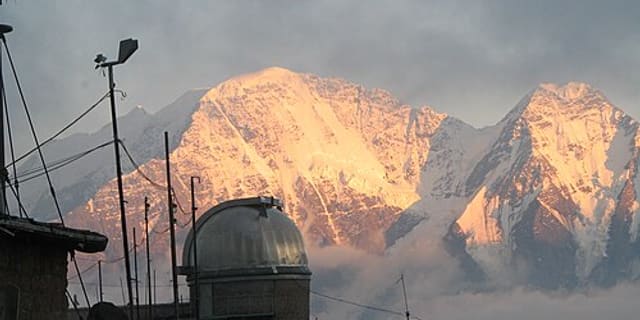
The observatory lies in the Baksan gorge in Kabardino-Balkaria, in the Caucasus mountains of Russia, at the entrance to a valley roughly 1,700 metres above sea level beneath the 4,000-metre peak of Mount Andyrchi.
Visiting Baksan Neutrino Observatory
BNO is an active research facility rather than a public visitor attraction, and its website does not list general tour information. Anyone hoping to visit should contact the Institute for Nuclear Research directly before travelling.
See your named star from here
Even a working physics laboratory like Baksan sits under the same sky as everywhere else, and a star's coordinates are the same wherever you view them from. If you would like your own reference point in the night sky, see the naming packages or browse the star catalogue.
Opening hours and public-visit programs vary by season. Check Google Maps for current times before you travel.
Institutional and reference sources used to verify this guide.
Satellite imagery: Esri, Maxar, Earthstar Geographics

 16 km
16 km
 16 km
16 km
 111 kmResearch
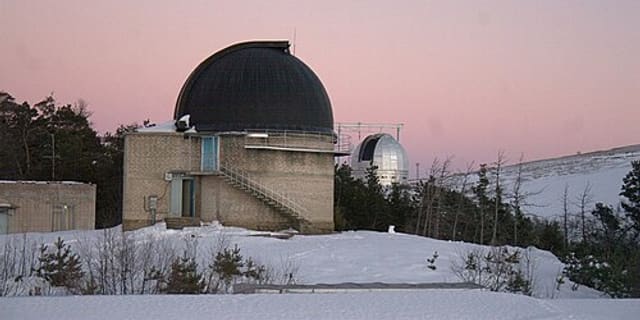
Astronomical station at North Caucasus of Kazan Federal University
astronomical observatory in Russia