
Dominion Astrophysical Observatory

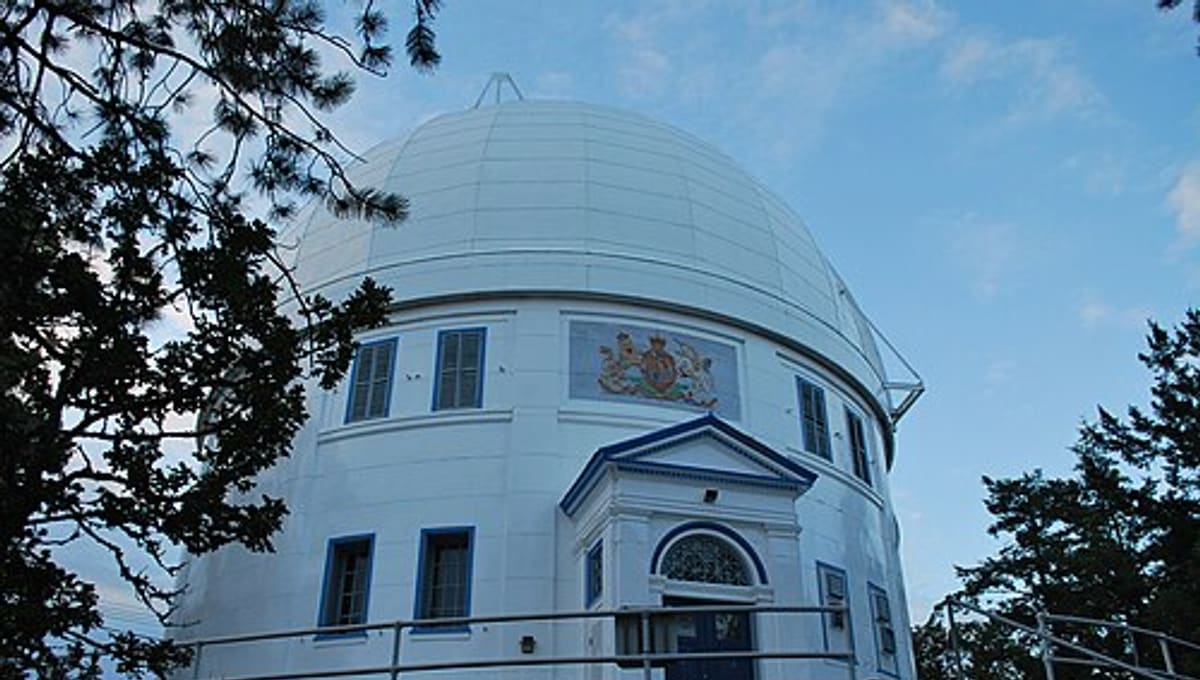
Image: Wikimedia Commons
Dominion Astrophysical Observatory sits atop Observatory Hill in Saanich, near Victoria, British Columbia, and has been one of Canada's most important astronomical sites since it opened in 1918.
About Dominion Astrophysical Observatory
Completed in 1918 by the Canadian government, the observatory was designed by Dominion architect Edgar Lewis Horwood. Its centrepiece is the 72-inch (1.83 m) Plaskett telescope, proposed and designed by astronomer John S. Plaskett in 1910 with backing from the International Union for Cooperation in Solar Research. Plaskett went on to lead the observatory until 1935.
History
Dominion Astrophysical Observatory has been designated a National Historic Site of Canada in recognition of its role as a world-renowned research facility. From its opening until the 1960s, it ranked among the world's leading astrophysical research centres, and astronomers working there made discoveries that helped shape our understanding of the structure of the Milky Way.
Telescopes & research
The observatory's main instrument, the 72-inch Plaskett telescope, was among the largest in the world when it was built and remains the site's signature instrument. Research carried out here over the decades focused heavily on stellar and galactic astrophysics, contributing to the broader study of the Milky Way's structure.
Location & getting there
The observatory is located on Observatory Hill in Saanich, British Columbia, at an elevation of 227 metres, a short drive from Victoria on Canada's Pacific coast — a setting that combines relatively easy access with dark, elevated skies above the city.
Visiting Dominion Astrophysical Observatory
As a historic and still-active research site, opening times, tours, and any public astronomy nights are best confirmed on the observatory's official channels before visiting, since access to a working research facility can vary.
See your named star from here
Standing where the Plaskett telescope has studied the Milky Way for over a century, it's worth remembering that a star named through Star Register comes with its own precise coordinates, ready to be found by any telescope, anywhere. Search the star catalogue to choose yours.
Opening hours and public-visit programs vary by season. Check the official website and Google Maps for current times before you travel.
Institutional and reference sources used to verify this guide.
Satellite imagery: Esri, Maxar, Earthstar Geographics

 83 km
83 kmGolden Ears Observatory
astronomical observatory in Maple Ridge, British Columbia, Canada

 114 km
 126 km